Upload BOM & Gerber

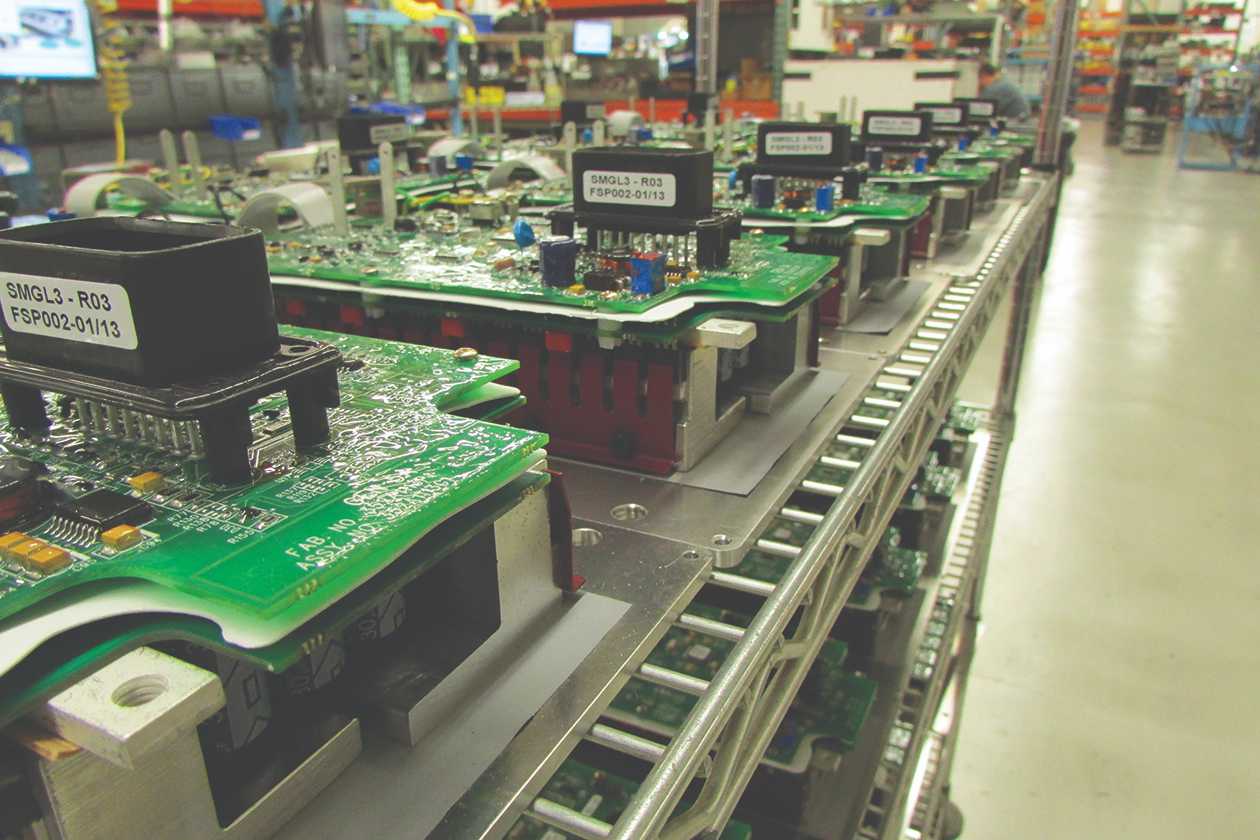
Electronics manufacturing is the process of taking the product specification and converting it into an actual physical product with associated documentation proving the acceptance of each item produced. Each specific project could have its own series of steps beyond fabrication which could include PCB assembly, programming, wire harness assembly, chassis assembly, testing, and packaging, etc. Some manufacturers use in-house production, some outsource to CMs, while some have ODMs perform both the design and manufacturing on their behalf, with or without in-house capabilities. The overall definition of a project's parameters will remain incomplete until you assign design authority, material selection responsibility, inspection/testing, changes to be made, and shipping authority to each applicable party to the project.
Contents
show
What Is Electronics Manufacturing?
To exercise control over the production of electronics manufacturing, a specific and known input is necessary; an exact definition of how to convert the input to a physical output must be established; the final physical output must be documented as proof of acceptance. If any of these elements are missing, the project may still be in the prototype phase, buying directly based upon a loose definition of what was purchased, or getting an untested and unproven product with no traceable requirement. The NAICS classifies computers, communications equipment, audio/video equipment, electronic components, and various instrument types under Subsector 334 (US Census Bureau). The NAICS classification makes clear that there is a broad range of products within the electronics manufacturing industry and that projects must have a more narrowly defined operating definition.
A bare PCB is just a blank, bare board; when it has components installed and soldered, it transforms into a PCBA. At the module and box build stages of manufacturing, products can be combined with cables, mechanical assemblies, firmware, or higher-level testing/verification as necessary. In addition to the manufacturing process, final products may also require additional configuration, labeling, accessories and packing.
The levels indicate potential limits for delivery, but do not represent a defined order of operations. In terms of the bare PCB production and PCB assembly processes, the detailed discussions concerning how each of these processes works describe how to identify objects, transformations, and acceptance packages.
Why Electronics Manufacturing Is Not the Same as EMS
Electronics manufacturing is simply an act; EMS and CM are both supply models that are conducted externally by others. An OEM may also be involved in the internal processes of an electronics product, while an ODM can combine the design and manufacturing of that product under a different commercial arrangement. When looking at an ICT assessment from the U.S. Commerce Department and Department of Homeland Security, we can see that EMS contractors control the production of a manufacturing process, whereas OEMs maintain control of product development; however, in an ODM environment, the contractor controls the design and development of that product (U.S. Department of Commerce/U.S. Department of Homeland Security).
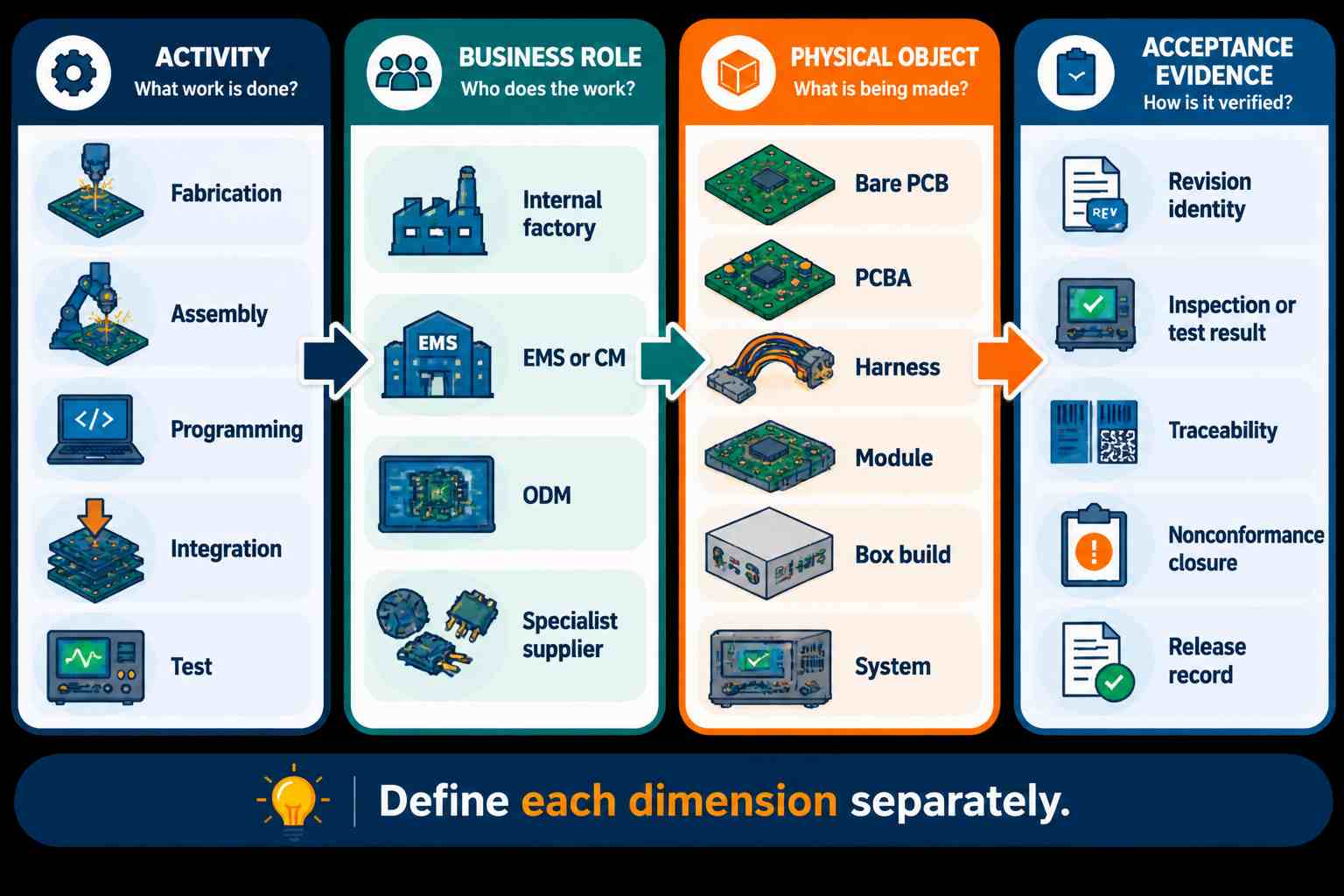
OEMs delegate detailed design work to their suppliers while retaining ultimate product requirements control, including test fixture or test process development by EMS providers, or the use of specialist suppliers by ODMs. The actual arrangements are defined by contracts, controlled documents and applicable law.
For example, asking "Does this company produce electronics?" fails to provide useful content. A better question would be to clearly identify the deliverable (possibly the same for multiple customers), define the release maturity criteria, volumes and mix by product, all transformation processes, material splits, acceptance criteria, data exchange process and shipment authority. Only after providing this information is the EMS label useful.
Who Owns What in OEM, EMS, and ODM Programs?
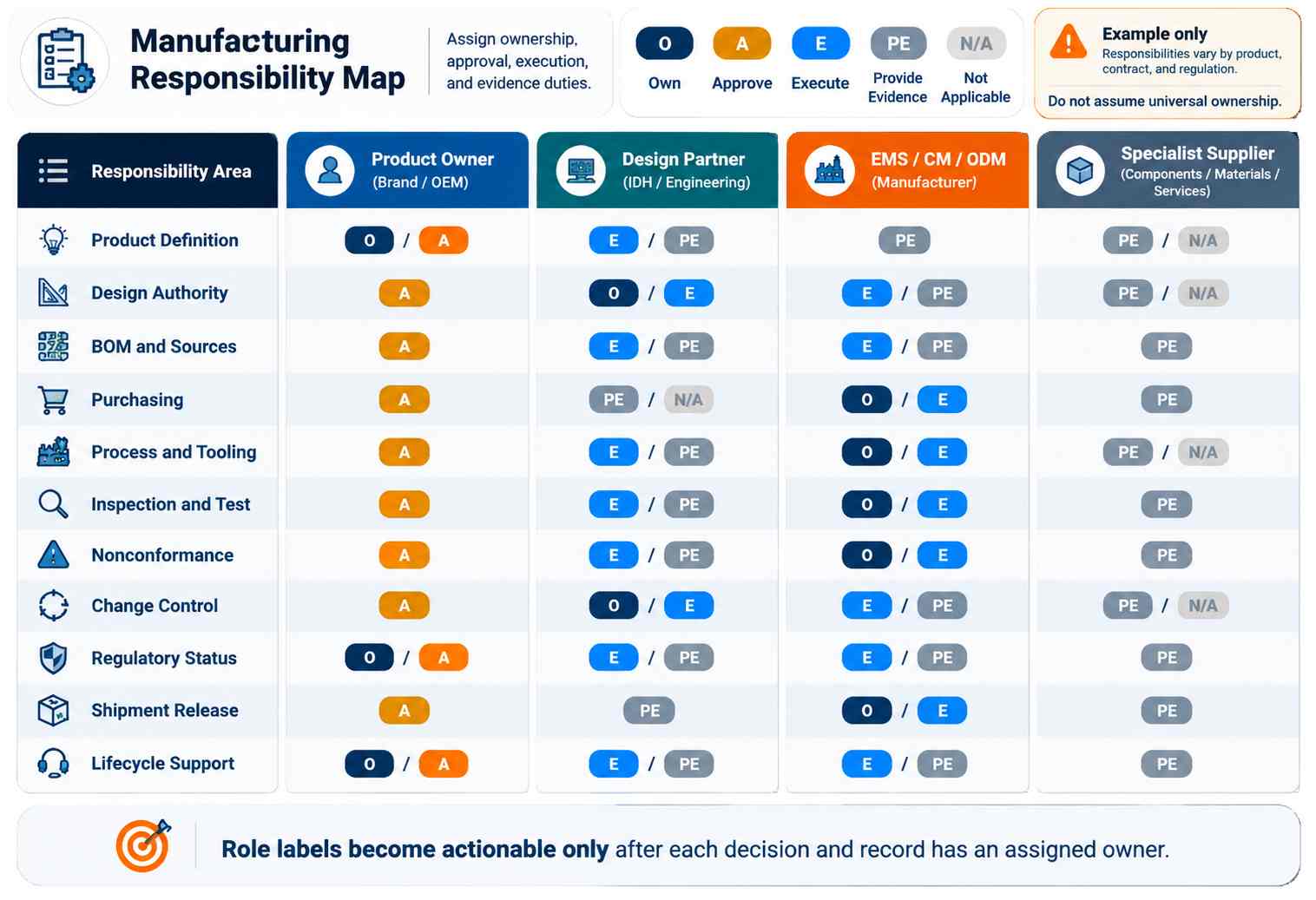
In OEM, EMS and ODM programs, "Project responsibility is defined by a documented assignment rather than an acronym on the supplier's door." Each project must have an assigned owner, approval of the project, execution of the project and provision of records for the project. The assignment of responsibilities can change based on the type of product, the type of market, the stage of the product lifecycle and even the types of contracts, even if the organizations themselves do not change.
Under applicable EU product law, the manufacturer retains the ultimate legal responsibility for the products even if they subcontract any part of the design or production processes. The European Commission's Blue Guide indicates that the manufacturer must continue to exercise overall control and retain any information needed to meet their obligations (European Commission).
A responsibility worksheet should be created prior to requesting a quotation for production; do not prefill the responsibility worksheet with any blanket assumptions.
Material responsibility is one row in the overall process of producing an item and should be compared with turnkey material responsibility once a change authority and list of approved sources have been defined.
NIST's MEPNN intake requests include processes, dimensions, tolerances, performance, materials, certifications, regulations, volume, price, delivery, packaging, and drawings. NIST distinguishes between complete and partial capability matches; however, the requester has the responsibility to validate fit (NIST).
How Does a Product Move From Release to Shipment?
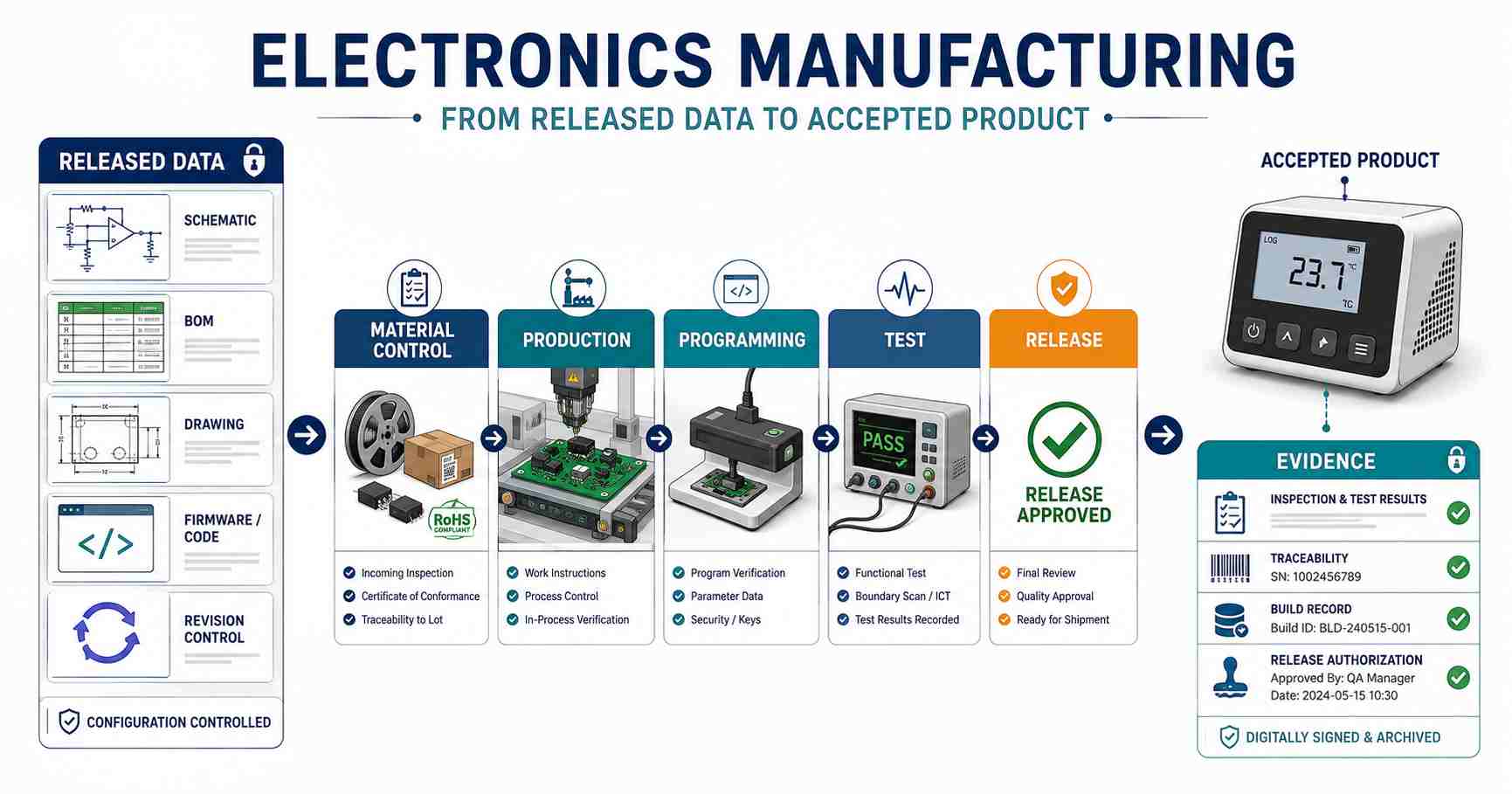
A product moves through decision gates, rather than from an all-inclusive list of machines. Each decision gate receives controlled input and produces an exit record. Downstream work must not rely on informal knowledge that does not correspond to the approved configuration.
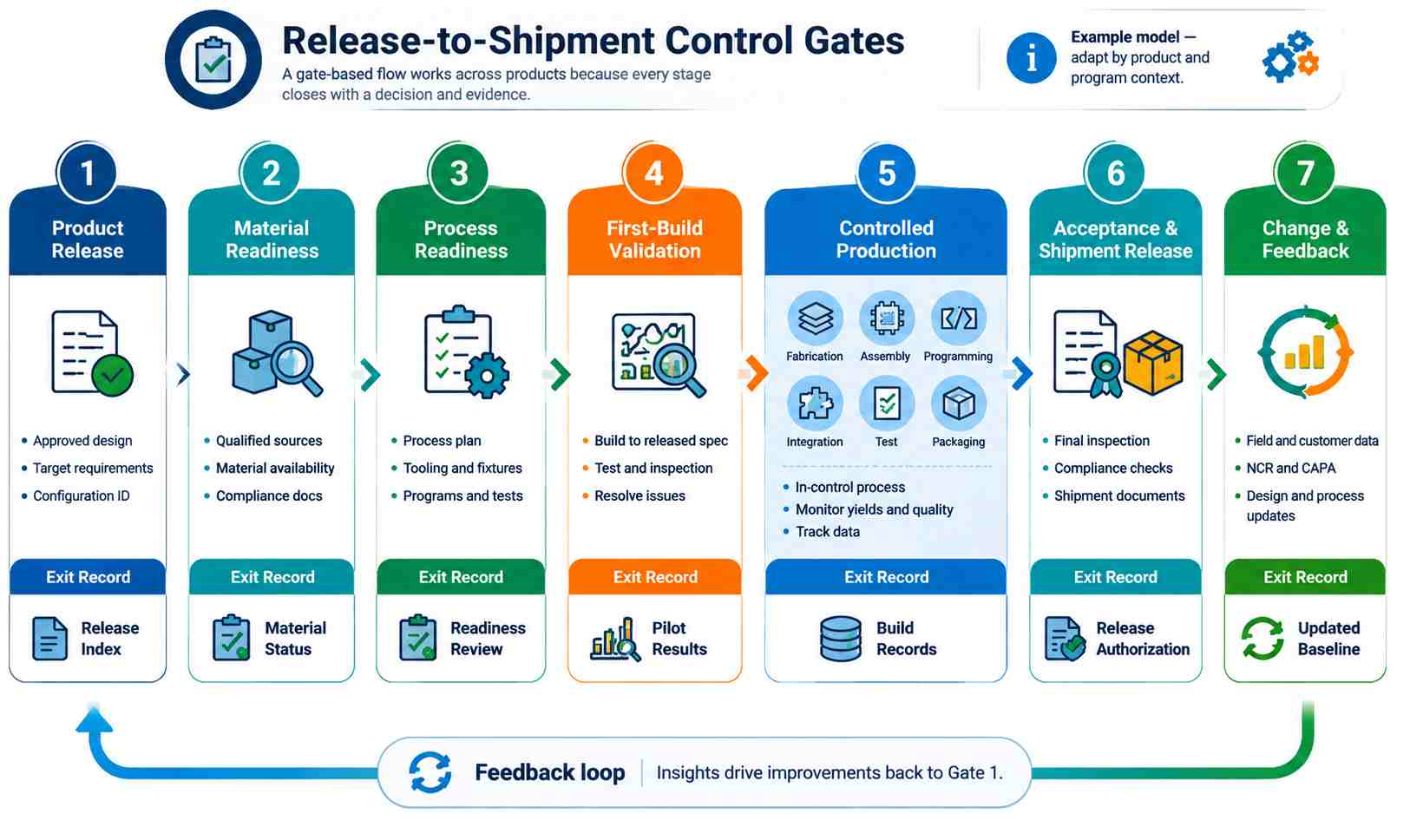
DFM should be resolved prior to production release, unless there is an approved "open issue" that has been carried through a controlled change process. During NPI, manufacturability reviews can also facilitate controlled changes prior to volume production. Validation of the first builds tests the released definition against the actual route, tooling, materials, programs, and test method used.
Revision and First-Build Control
Mixed revisions and unauthorized substitutions can be prevented from reaching the production line with the implementation of product and material release processes. The process-readiness check determines if the equipment is available, but it also verifies whether the SMT placement program, test limits, and work instruction revision that have been loaded onto the floor match the respective package that has been released for that specific item. A line that was originally producing with yesterday's program revision that has since had a component change in the last 24 hours could produce a complete lot of good units through every in-process check with no indication that they are in compliance with the current release. Because of this, no amount of inventory of available equipment would identify the issue through equipment inventory alone.
Execution follows the handoff object and may include routing through some or all of the following areas of operations: manufacturing, PCBA, cable, programming, mechanical integration, testing, packaging. A circuit card assembly may leave at the board level and a box build travels through enclosure and configuration work. The execution for boards when they reach the board level will include some or all of the following: acquisition of components, kitting of components, SMT or through-hole assembly, programming, inspection, electrical testing/functional testing, and pack-out.
Repeatable lines are capable of going through a setup without being verified. Any pilot run's results should be closed out with any open actions completed before production gets underway. A list of Manufacturing Order deliverables is checked against the shipped lot based on acceptance. This process includes checking and matching the measured/tested results from the released criteria to ensure that all open nonconformances have been resolved or dispositioned and that the as-built configuration matches the approved revision. Any engineering changes approved during a pilot phase do not represent positive feedback until all BOMs, test limits, and work instructions are updated to reflect those changes.
Shipment Acceptance and Traceability
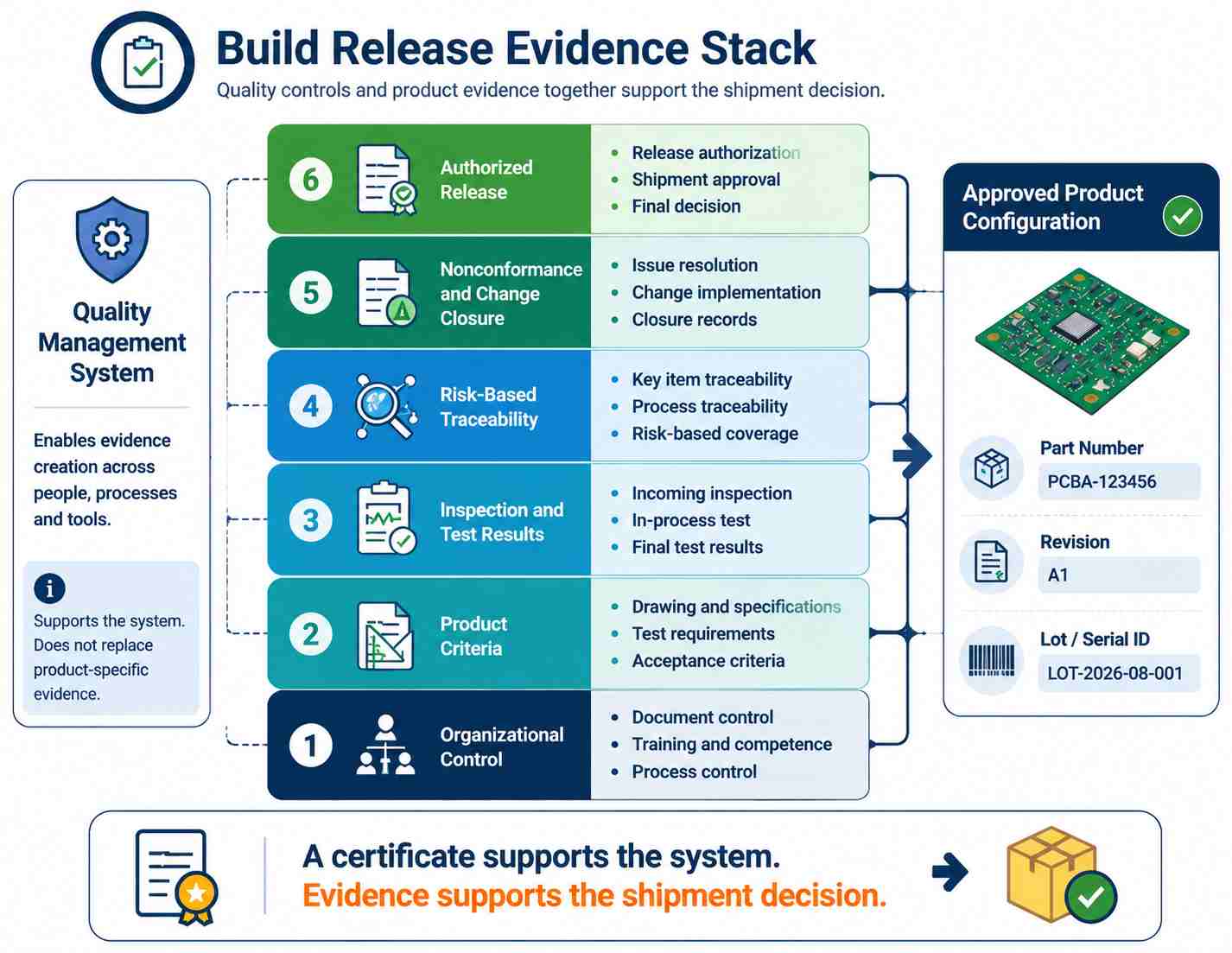
Evidence supporting shipment readiness includes agreements regarding SHIP criteria between parties; verification through documents connecting SHIP criteria, SHIP configuration, material, and ship history. Quality Management Certification does not prove that each specific unit or lot meets all of the requirements.
The depth of traceability should be determined by the level of risk rather than through a universal record list. The IPC-1782B Document Scope provides for risk-based Manufacturing & Supply Chain Traceability across PCB fabrication, PCBA, and Mechanical Assembly (defined by the Global Electronics Association Standards Catalogue); the Normative Information will be located in the Paid Standards Document. Projects should not create fields or establish retention requirements outside of the Public Summary. Public CFX 2.0 describes connected data that can simplify Data Exchange Processes and be referred to as CFX. IPC-2591, CFX covers messages for Work Orders, Material Inventory, Process Reading, Inspection Records, Test Records, Repair Records, and Routing.
Inspection and Test Coverage
Inspections are directed at the features or conditions specified on a product requirement, while Testing applies to defined Stimulus, Measurements, or Functionality Checks. Consequently, PCB Inspection methods must be determined based on the Object and related Risk Factors. Therefore, once it has been identified which inspection and testing functions are to be utilized for PCB Assembly, only those methods which apply to the defined coverage and have associated acceptance limits shall be utilized for Acceptance or Certification. For PCB Assemblies, SPI, AOI, and X-Ray are suitable for inspecting Process/Assembly Features, while ICT and Functional Tests provide Electrical or Functional Validity. The determined Acceptance/Certification Value will depend upon the defined coverage and established acceptance limits.
Choosing In-House, Outsourced, or Hybrid Production
Select a production boundary following the definition of the handoff object, product maturity, retained decisions, and record exchange; promises of lower cost, faster launch, or improved quality are generalities that do not define results dependent on release quality, volume and mix, supplier fit, internal capability, logistical systems, change controls and failure exposure.
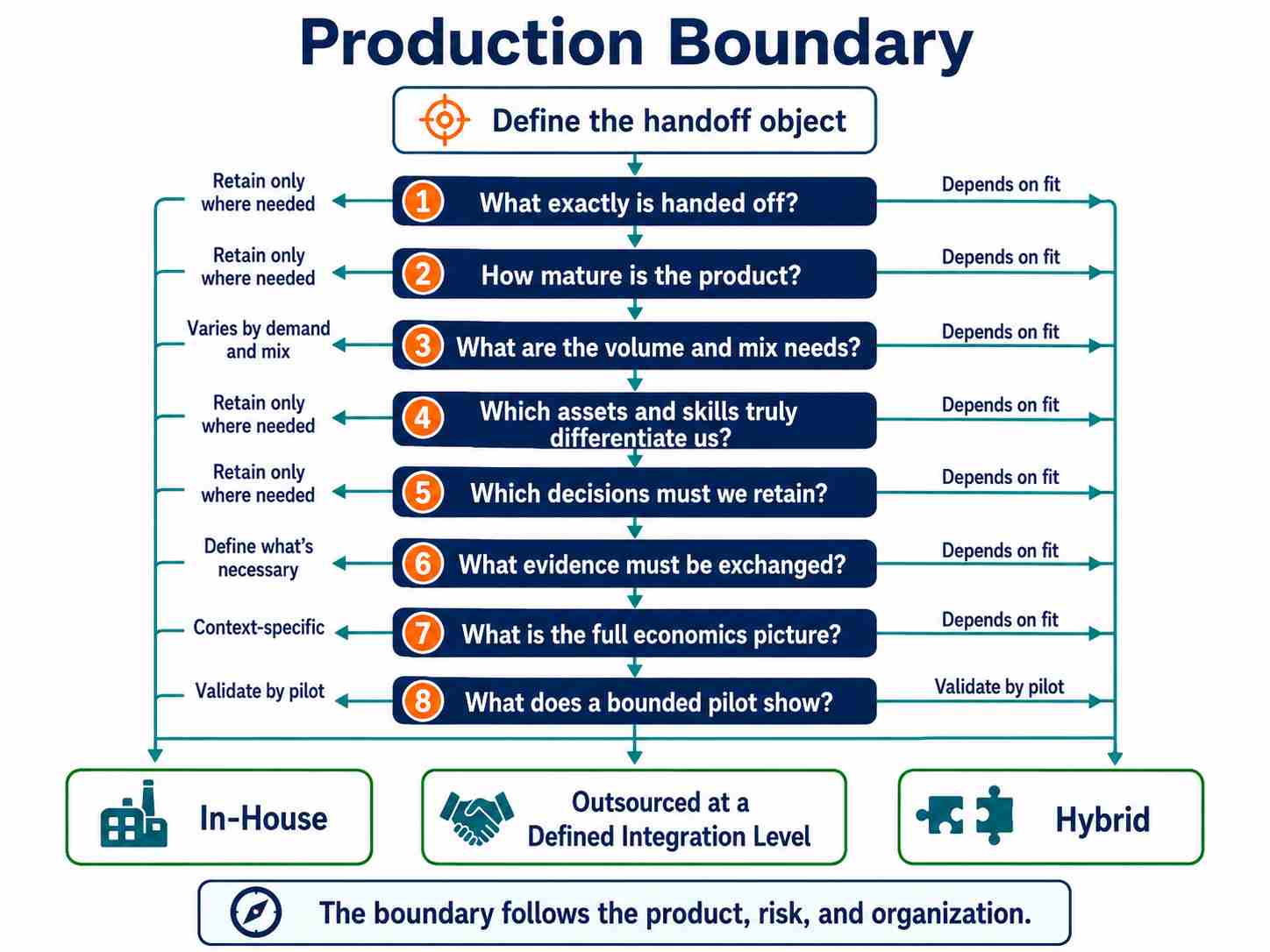
Companies can outsource to reduce capital costs while increasing volume and specialized capabilities from the outsourcing company; however, outsourcing may be negated by the costs of tooling, qualification, logistics, inventory management and quality control and longer delays in making changes to the product.
- Define the handoff object. Is the deliverable going to be a PCB, a PCBA, a module, a configured box build, or a finished system?
- Separate uncertainty in a prototype from confirmed production releases. A quotation will not solve all uncertainty surrounding requirements, test limits, and interfaces.
- Quantify the volume and mix of product. Record the lot sizes, variations, revision rates, seasonalities, and ramp-up times; avoid terms like "low" or "high."
- Inventory the unique assets and abilities that are owned by your company and its counterparties. Think process engineering, test development, sourcing, software development, quality assurance systems, lifecycle support, special tooling, domain expertise, and the associated costs involved in recreating those assets and abilities after the transfer of ownership.
- Mark the retained decisions. Safeguard design authority, proprietary intellectual property, approved suppliers, regulatory statuses, or final release where the business requires control over those elements.
- Refer to the record exchange. Define identifiers, formats, frequency of transfer, retention periods, access protocols, and escalation procedures prior to selecting a software solution.
- Model the total economic picture. Include the capital expense and nonrecurring engineering costs as well as all tooling costs, qualification costs, unit prices, yield, inventory and logistics costs, quality control oversight costs, time required to make changes to the engineering design, and costs associated with field failures.
- Pilot the process.
Hybrid sourcing arrangements can also be effective. One firm may hold the architecture, regulatory status, strategic approval to source, and final release, while the other outsources PCBAs and box builds. Another firm may maintain an engineering resource for rapid development and outsource stable volumes.
When selecting potential partners, ensure that the partner's actual boundary can be tested. To determine this, request an anonymized or representative build package including revision control, material identity, readiness, inspection/test results, nonconformance closure, traceability, and shipment authorization. In addition, compare required manufacturing capabilities against the product's object, total volume and mixed manufacturing methods, and the agreed-upon build package.
Frequently Asked Questions
Q1. Is "electronic manufacturing" the same as "electronics manufacturing"?
"Electronic manufacturing" and "electronics manufacturing" are two phrases that describe the same broad industrial direction/sector. As with any other industry or business area, companies prefer one over the other, but the two phrases do not convey a different production process. In the context of an actual program, the important points of reference are that an organization must produce the physical product, provide a physical item, and provide acceptance proof.
Q2. Is CM the same as EMS?
CM and EMS provide the same services to clients but are viewed by industries from different angles. CM is the broader term used across many industries and can refer to CM of electronics, clothing, food, and pharmaceuticals. EMS is the term that refers specifically to the electronics industry. The company that refers to itself as an EMS or as a CM may do the same scope of work, the title denoting an industry-wide convention, not a difference in the service being provided.
Q3. Should I contact an EMS for my first prototype, or should I hire a design partner?
Contact an EMS for a quote if you have a design that contains a released schematic, layout, and BOM. If your design has not yet completed DFM review, test strategy definition, or has not resolved its component sourcing, resolve these gaps internally or employ a design partner to remedy these issues. An EMS providing a quote on an incomplete design package will price the risk of the uncompleted items into the pricing or it will return the design to you for rework before manufacturing.
Q4. Who owns the intellectual property of an ODM product by default?
There is no industry-wide practice as to who holds the IP for an ODM product by default. How IP ownership is designated is established in the contract, and not by the ODM business designation. If the customer wants to retain exclusive rights, prevent sales of the same design to a competitor, or take the design to another manufacturer in the future, the customer will typically have to coordinate these requests with the ODM prior to the product's development.
Q5. Does every product require IPC-1782B traceability?
No. The level of required traceability is based upon the product's level of risk and applicable regulatory requirements, not as a flat requirement. For example, a safety-critical or regulated product (medical, automotive, or aerospace) will usually require full component lot and process-level traceability sufficient to support a complete recall investigation. In contrast, a consumer accessory that is non-critical will generally require only lot-level documentation from incoming inspection and final testing. The IPC-1782B does not provide for a single traceability tier; the level of traceability for a product is based upon the consequences of failure and the regulatory obligation imposed by the product.
References & Sources
- 2022 North American Industry Classification System – US Census Bureau
- Assessment of the Critical Supply Chains Supporting the U.S. Information and Communications Technology Industry – U.S. Department of Commerce and U.S. Department of Homeland Security
- The Blue Guide on the implementation of the product rules 2022 – European Commission
- Finding US Suppliers with MEPNN – National Institute of Standards and Technology
- IPC-1782B Standard for Manufacturing and Supply Chain Traceability of Electronic Products – Global Electronics Association
- IPC Standards Revision Table – Global Electronics Association
- IPC-2591, Connected Factory Exchange – Global Electronics Association
- About CFX: The Global Standard for Smart Manufacturing Enablement – Global Electronics Association
- ISO 9001 Quality Management Systems – International Organization for Standardization
- Machines That Build Your Electronics – Factory Tour, Meline Group – Robert Feranec