Upload BOM & Gerber

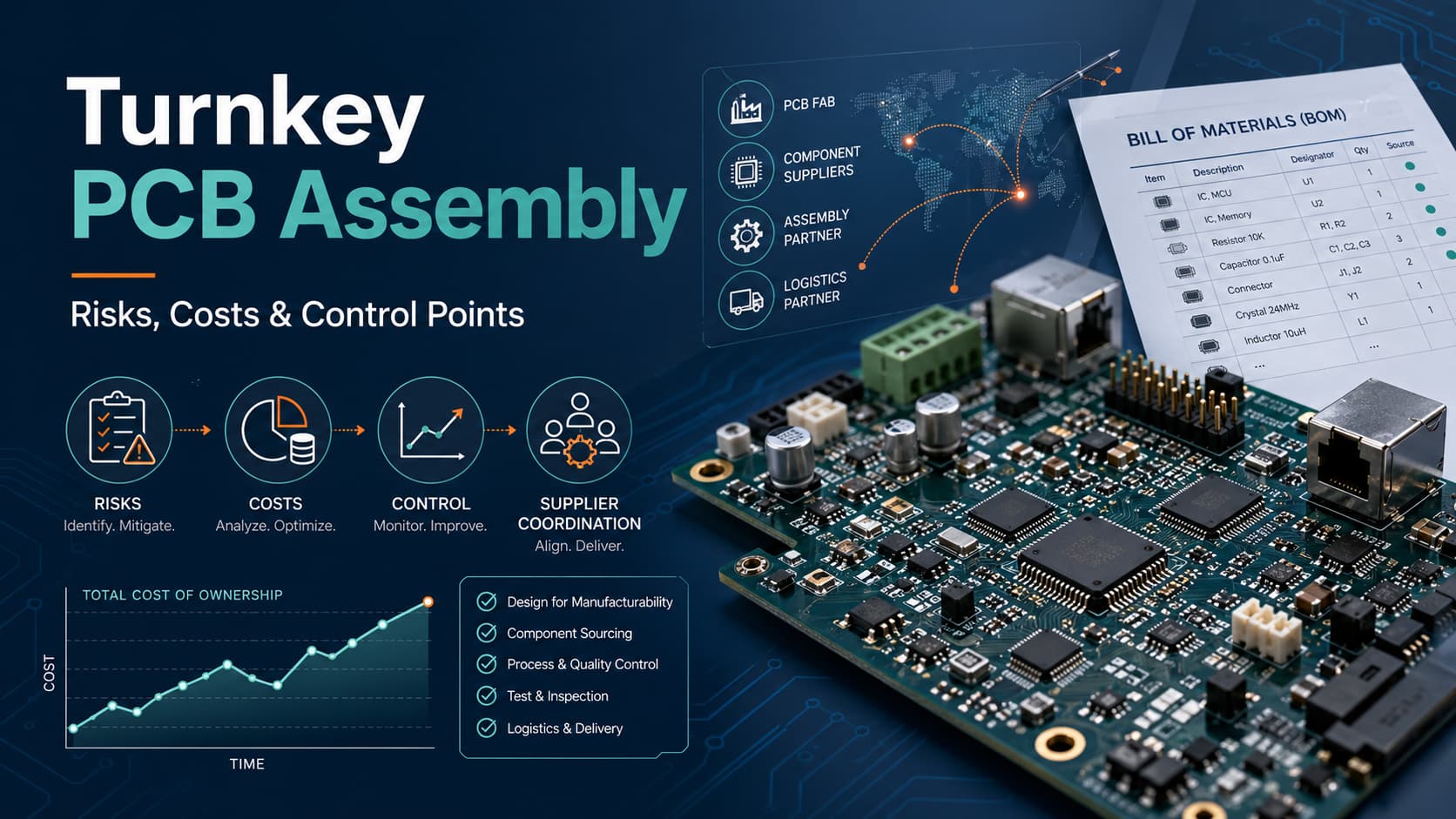
Turnkey PCB assembly is commonly seen as a streamlined outsourcing model: send your files, let someone else buy your components, build your PCB assembly, and send back a finished unit.
This is a convenient perspective, but it obscures the most significant aspect of the model. Turnkey PCB assembly transfers the function of performing work between you and another party; however, it does not eliminate the requirement for defined approval authority for the project. To look at this model from a more relevant perspective, we can consider the project from a risk, cost, and control perspective. Although component sourcing has moved to the vendor side, the customer must still define the bill of materials (BOM), acceptable alternates, substitution rules, test expectations, and escalation path before the first build begins. The absence of these parameters can make the project appear efficient on paper, but once component shortages occur, design changes are enacted, rework requests are submitted, or acceptance issues arise, the project becomes increasingly difficult to audit.
In this article, the operating logic of turnkey PCB assembly will be discussed rather than repeating the basic service definition as shown in full turnkey PCB assembly services. The following sections explain how responsibilities change in the turnkey model, where costs come from, and what control points should remain visible throughout the process.
Contents
show
Turnkey PCB Assembly Is a Responsibility Model, Not Outsourcing Everything
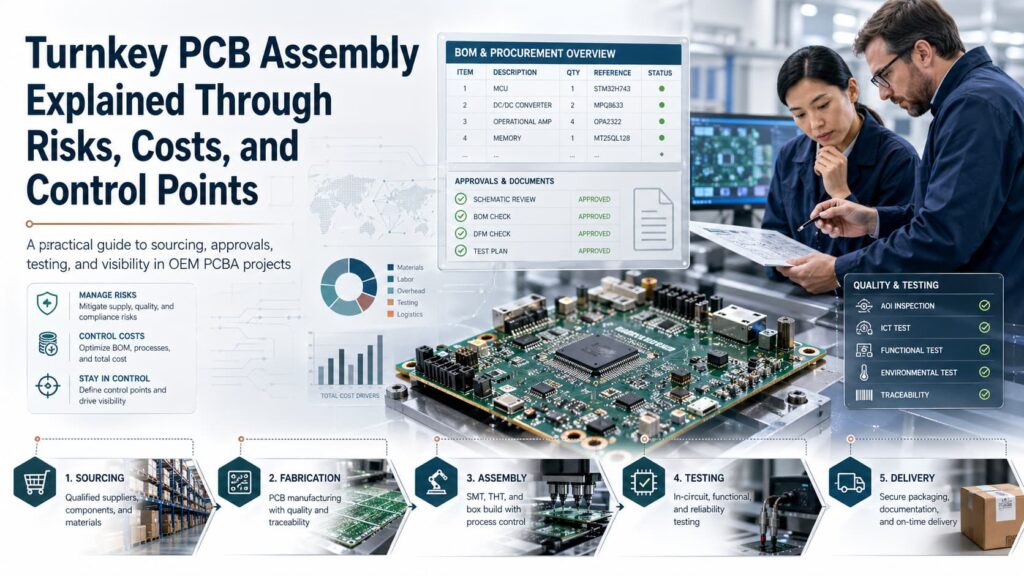
Turnkey PCB assembly refers to how responsibility is divided between two companies. It specifies, for example, who is responsible for sourcing materials, coordinating fabrication, executing assembly, managing testing and inspections, and transporting goods. This does not mean the company making the products has no say in their engineering.
Notably, PCB assembly projects are not simple purchases. Each project contains design intent, released documentation, material assumptions, process expectations, and rules for acceptance. Turnkey arrangements may ease the burden on clients to coordinate work with multiple suppliers, but it is still critical to define which party has final authority to approve design changes and how exceptions to the planned process will be handled.
What execution responsibility shifts to the supplier
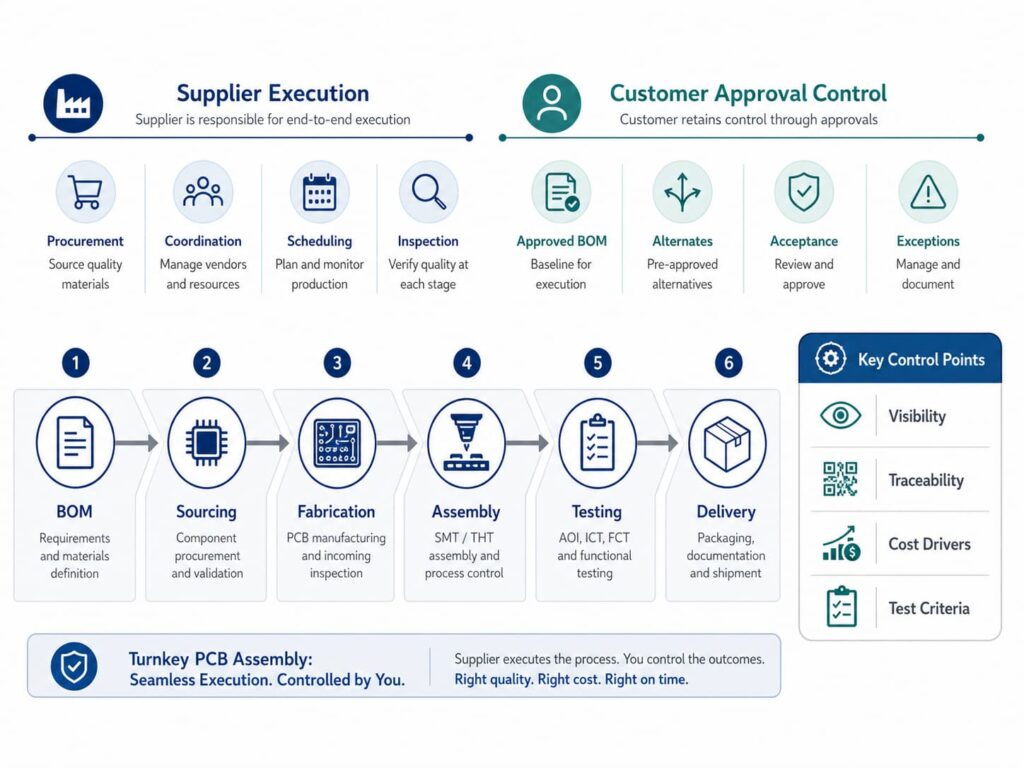
The burden of operational execution tends to shift from customers to suppliers when clients decide to use turnkey PCB assembly. Suppliers usually take responsibility for the agreed execution scope, including sourcing components, coordinating with fabricators, managing assembly schedules, consolidating production records, and coordinating inspection and testing of the finished product based on the agreed build package.
This can streamline the client/supplier relationship because the client no longer has to communicate with several separate suppliers, such as the fabricator, component suppliers, assembly suppliers, and shipping partners. A single point of execution generally makes the process easier for clients to manage.
Execution does not grant authority to a supplier. Under the customer’s predefined framework, suppliers have the ability to execute against the approved BOM, drawings, Gerber or ODB++ files, assembly files, test requirements, and revision files. However, the client retains responsibility for establishing which documents constitute the final authority and defining what constitutes an approved revision.
Substitute connectors that have the same number of pins and the same pitch as the original connectors may differ in several project-critical aspects. For example, a replacement connector may have a different housing shape, latch position, mechanical footprint, mating interface, plating process, insertion-force requirement, or mating-part compatibility. If a supplier treats this type of change as a typical purchasing decision, the assembly may work correctly while system integration still fails.
What customers should still control
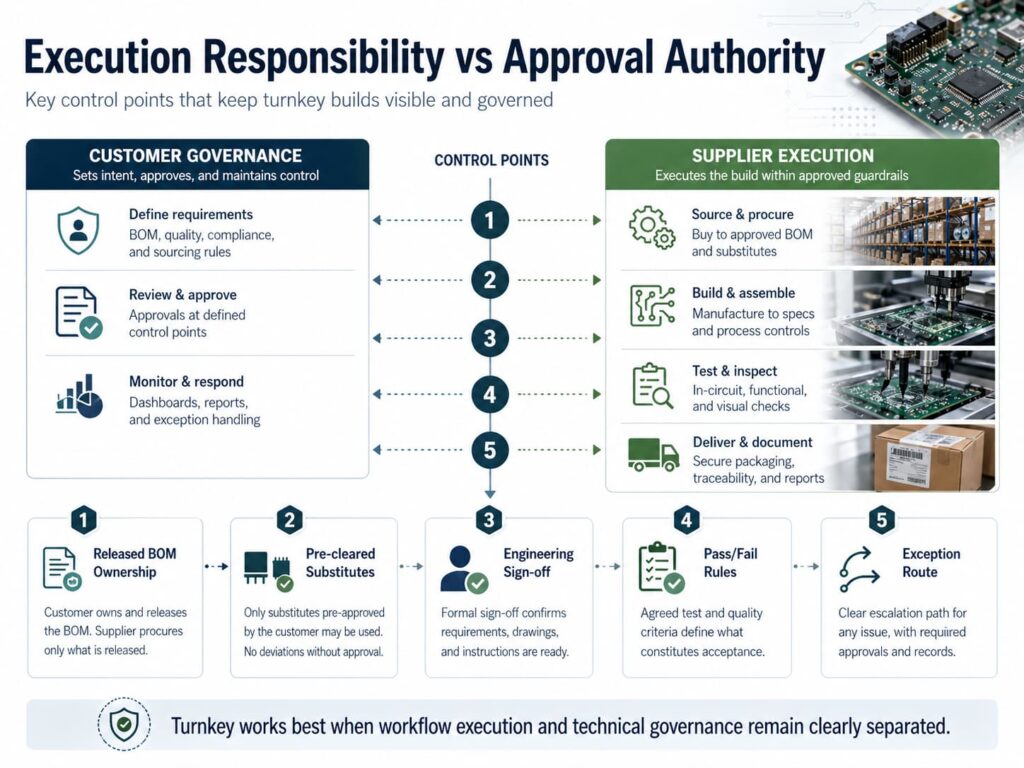
Customer-side control should be maintained where product function, reliability expectations, and acceptable business risk are concentrated. The BOM released by the customer should include approved manufacturer part numbers, do-not-substitute parts, customer-approved alternates, and parts that require engineering review prior to any changes.
While alternate parts have their own challenges, the most important discipline is what to do if an alternate is needed due to an unforeseen circumstance. A substitution may have the exact same electrical characteristics on paper; however, the customer may still face risks such as package differences, lifecycle status, firmware dependency, temperature rating, certification constraints, derating factors, thermal impedance mismatch, and long-term availability. Therefore, the customer’s engineering team must approve alternate replacements before they are bought or incorporated into the product.
Acceptance criteria are also an area of customer control. Inspection methods provide information about specific types of defects, but they do not define what is acceptable within the project. Expectations regarding workmanship, rework limits, required evidence, and test conditions need to be clearly identified prior to production release.
If inspection methods and acceptance criteria are not clearly defined, the results from the same inspection may be interpreted inconsistently by engineering, procurement, and production personnel.
Why unclear control points create project risk
Turnkey projects carry significant risk when the authority to execute and the authority to approve are treated as one and the same. For example, while a supplier is responsible for obtaining parts, the customer must still approve any alternate that affects the approved product assumptions. While the supplier manages test execution, the customer ultimately defines the purpose of the test.
The principal risk associated with unclear customer control points is determining who had the authority to approve a change, reject a substitution, release a deviation, or accept a marginal result. Without clear control points, it becomes difficult to make quick decisions on changes, substitutions, or deviations.
A strong turnkey model separates workflow management from engineering governance. The supplier manages workflow execution under the agreed contract, while the customer maintains control over design intent, material changes, and acceptance boundaries. This separation is crucial to the distinction between a managed turnkey model and unmanaged outsourcing.
Full Turnkey, Partial Turnkey, and Consigned Assembly: What Actually Changes?
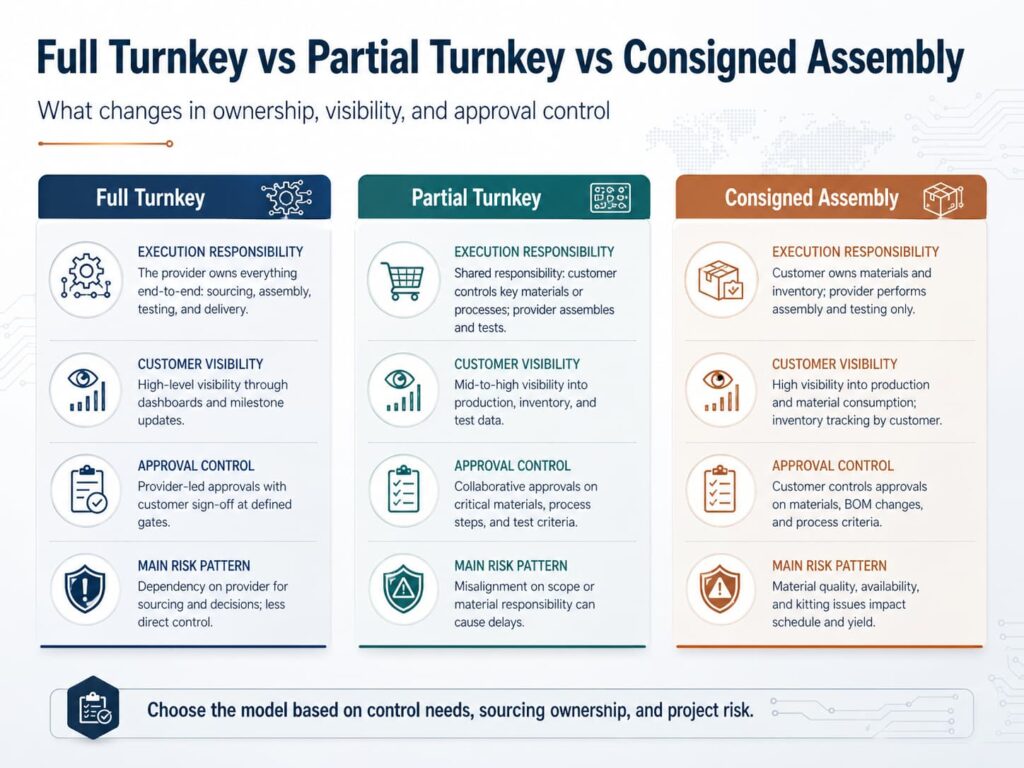
The difference between full turnkey, partial turnkey, and consigned assembly is not only determined by who buys the parts. It is determined by how responsibility, visibility, approval control, and risk responsibility are allocated among all parties involved in the build.
Two projects can be made from the same fabrication data, assembly files, and inspection processes; however, the engagement model can lead to different decisions when parts are unavailable, alternate components are suggested, incomplete parts arrive, or deviations occur during assembly.
Full turnkey: supplier-led execution
In full turnkey projects, the customer continues to provide design intent, released documentation, BOM, and acceptance expectations, while the supplier takes on more responsibility for the execution process.
This method decreases the number of transfers between purchasing, fabrication, and assembly. Production documentation may also be easier to combine when materials, boards, assembly flow, and final release are managed within one execution path.
A potential challenge of the full turnkey model is maintaining visibility into the decision process. If the customer only receives the final assembled product, decisions regarding sourcing or deviations could be lost within the execution process. A stronger model allows the customer to review sourcing records, alternate approvals, shortage notes, inspection results, and assembly deviation documentation.
For instance, when a voltage regulator becomes difficult to procure, the vendor may suggest a substitute part. This suggested part must be reviewed against output tolerance, thermal margin, transient response, derating factors, package thermal impedance, operating environment, and prior validation assumptions. The issue is not the suggestion itself, but approving the replacement without sufficient engineering review.
Partial turnkey is useful when selected components need to come from the customer because of contractual obligations, proprietary control, allocation limits, or internal qualification rules, while the supplier still manages the wider build workflow.
The risk associated with this model is interface management. If customer-provided parts arrive late or lack traceability to the bill of materials, the supplier’s schedule can change. Each component category needs an owner, and the owner must know the packaging, labeling, quantities, documentation, and shortage-handling rules for those parts.
As an example, consider a microcontroller provided by a customer for its system. The vendor may have all remaining components ready. However, if the microcontroller arrives with the wrong documentation version or no programming instructions, this can delay completion of the vendor-managed portion of the assembly.
Consigned assembly: customer-supplied materials
Consigned assembly helps a company maintain control of materials when parts have already been purchased, qualified ahead of time, or monitored internally.
The downside is that procurement risk remains with the customer. If the kit sent to the supplier contains wrong parts, damaged parts, missing parts, or parts that do not match the latest release, assembly may be delayed even if the supplier has completed its preparation.
Discipline plays a major role in consigned kitting. Moisture-sensitive items require special handling, and quantity overage, lot information, packaging condition, and part labeling all affect whether the build starts in an orderly fashion. A supplier may perform assembly well, but it cannot make up for kits that do not match the released build package.
Ownership, visibility, and risk differences
When considering ownership, visibility, and risk, four questions help identify which model fits best: who performs the work, who has visibility into decisions, who approves modifications, and who takes responsibility when information is incomplete.
No engagement model guarantees the elimination of all risks. A full turnkey model reduces coordination effort, a partial turnkey model allows customers to retain control of critical components, and consigned assembly allows stricter material governance. The model should be matched with the controls needed for the project rather than viewed as a guarantee against risk.
The Pros and Cons of Turnkey PCB Assembly Depend on Control Points
Many articles present the strengths and weaknesses of turnkey PCB assembly too broadly; for instance, it does not always result in a faster, more economical, or safer process. Its strengths are realized when customers and suppliers jointly agree on the right control points before proceeding with operational work.
Using control points as a reference can provide more guidance than simply referencing the benefits of turnkey PCB assembly. The same standard model can benefit one project while creating problems for another if clear agreements do not exist for alternate components, non-conformance issues, or product acceptance standards.
Benefits when control points are clear
By establishing clear agreements on control points, turnkey PCB assembly can create a disciplined coordination mechanism. With a single source controlling the end-to-end production flow, there are fewer organizations transferring production information back and forth.
Although this does not guarantee that a project will proceed without problems, it helps identify where delays occur. For example, delays can be traced to material availability, documentation issues, manufacturing constraints, assembly defects, waiting for approval, or shipment coordination.
The model can also assist with continuity of records. When sourcing release, PCB fabrication release, assembly records, inspection results, and testing output are managed through a single workflow, project history is easier to reference. Engineering teams use build documentation to track problems that arise when the actual build diverges from the original plan.
Build documentation also provides earlier detection of sourcing risks. A supplier responsible for managing component sourcing may identify obsolescence, lifecycle concerns, or alternate sources before production starts. That value can only be realized when the organization has already decided which changes are pre-approved and which require engineering involvement.
Drawbacks when visibility is weak
Weak visibility creates challenges for the customer. If the PCB assembly process is viewed as an event where the customer cannot see how components were substituted, how shortages were addressed, what fabrication deviations were implemented, or what rework decisions were made, it becomes difficult to understand the impact on reliability, compliance expectations, or long-term repeatability.
Another challenge is potential vendor lock-in. When sourcing data, alternates, test expectations, and production records are not well documented, it may become difficult to transfer production or assembly to another manufacturing path later. This does not mean all turnkey projects create vendor lock-in; it means documentation control must allow the customer to understand what was built, what materials were used, what revision it followed, and what acceptance criteria were applied.
A third challenge is limited cost visibility. Turnkey quotes often combine sourcing, assembly, testing, logistics, and project coordination into one commercial structure. That can be efficient, but it may also make it harder to see which cost drivers are material-related, design-related, test-related, or approval-related.
Reducing risk without micromanaging procurement
Good visibility may allow customers to review an item before it is used, but that does not mean customers need to approve every component on every purchase order. Good visibility should identify where customer review is necessary and where a supplier can proceed within agreed guidelines.
As a general rule, procurement controls should address BOM ownership, pre-cleared substitutes, engineering sign-off, approvals for non-listed alternates, pass/fail guidelines, deviation management, and exception timing. Customers do not need to oversee every supplier action, but they do need to approve any item that affects form, fit, function, reliability expectations, lifecycle position, or documented acceptance conditions.
For example, a passive component substitute may be acceptable if the value, tolerance, voltage rating, package size, temperature range, and approved manufacturer list were reviewed in advance. On the other hand, a connector, regulator, RF component, memory device, or programmed IC may require more intensive review because a “similar” part could affect system functionality.
The following table outlines how control points protect parts of the process while giving the customer clarity on supplier execution:
The separation of execution responsibility and technical responsibility supports better customer-focused turnkey PCB assembly results. The supplier should have enough latitude to control the workflow, while the customer retains oversight of decisions that affect product intent, risk, and acceptance.
Supply Chain Realities: Obsolete Components, Shortage Pressure, and Approved Alternates
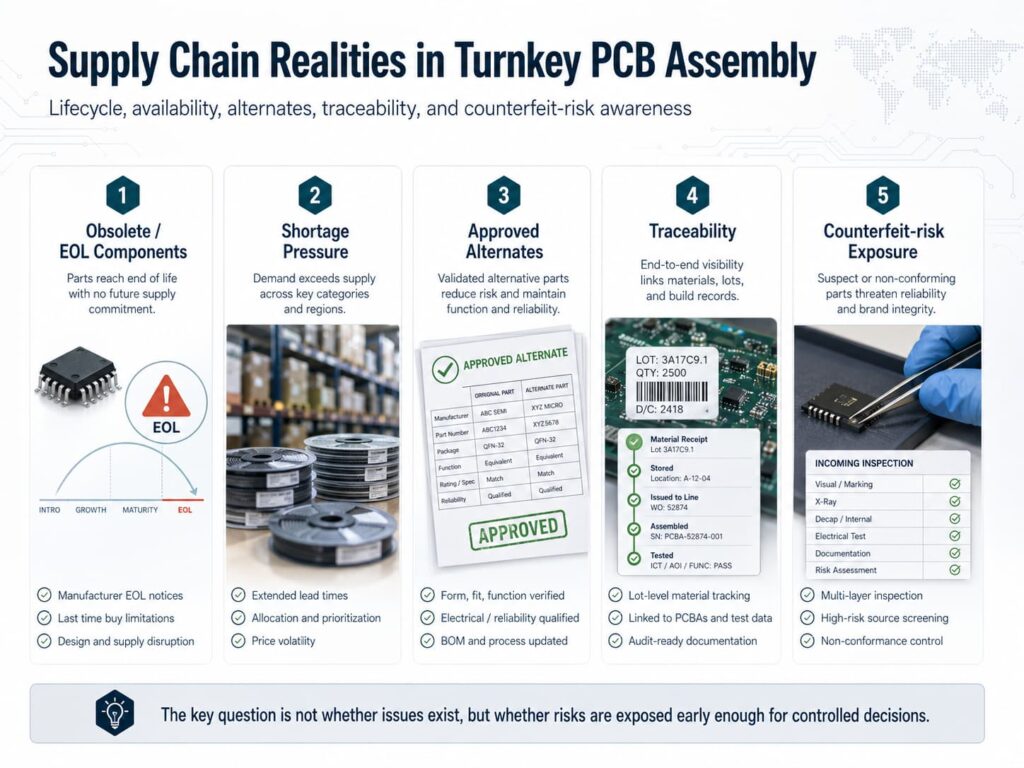
Supply chains today include obsolete components, shortage pressure, and approved alternates. Turnkey PCB assembly appears efficient from the outside, but it can contain hidden risk in the sourcing process. Customers need to understand how distributor searches, availability checks, lifecycle warnings, and alternate options are handled in the workflow.
The key question is not whether a supplier is capable of purchasing parts, but whether sourcing decisions are linked to the approved BOM, product requirements, revision control procedure, and acceptance expectations.
Obsolete and EOL components
Obsolete components create risk because they weaken the assumption that the product can be built repeatedly through the same process. Just because a component was used in a previous generation of designs does not mean its lifecycle position has remained the same.
Today, obsolete components may have an EOL designation, may no longer be recommended for new designs, and may be difficult to acquire through an authorized distribution channel. Although sourcing EOL parts may seem like an order-placement inconvenience, obsolescence can affect qualification status, redesign timing, production repeatability, and long-term serviceability.
A common example is an EOL microcontroller used in an existing product. Some suppliers may acquire additional stock of EOL items that remain qualified against the production BOM. However, the team may still need to consider firmware compatibility, programming flow, long-term service needs, last-time-buy decisions, and whether a redesigned circuit is more sustainable than continually sourcing legacy inventory.
The control point is lifecycle visibility. Customers need to know when a component has lifecycle concerns and whether the proposed path is a last-time buy, an approved alternate, a redesign candidate, or a temporary build decision.
Shortage pressure and substitution risk
When a product is under shortage pressure, an approved component in the BOM may still be difficult to source under required project conditions. Once that occurs, sourcing may shift to alternate sources, alternate date codes, other packages, or adjusted sourcing methods.
Responsibility in turnkey sourcing should be clearly defined. Turnkey suppliers provide the search process, whereas customers maintain control over decisions that affect form, fit, function, reliability, firmware behavior, or documented product assumptions.
Using a substitute that resolves a purchasing concern may create a new engineering issue. For example, substituting a regulator with the same nominal output voltage may still create differences in thermal margin, transient response, dropout behavior, package dissipation, and layout sensitivity. The board may power up in a basic test while still carrying reliability risk under load or temperature stress.
Shortage pressure should be managed using established exception routes. Routine availability updates can remain under supplier management, whereas material changes that affect the approved BOM should use documented review.
Approved alternates and substitution approval
Approved alternate components can reduce sourcing delay, but alternates should be approved by the customer before sourcing pressure occurs. Approval of an alternate component should not equal approval of “similar parts.” The customer should approve alternates based on electrical, mechanical, thermal, lifecycle, documentation, and product-use criteria before production use.
Ownership of the alternate list also matters. Some alternates may be approved for routine use, while others may be conditionally approved based on revision level, geographic location, lot number, or testing protocol requirements. Some components should remain do-not-substitute when tied to firmware, safety assumptions, calibration performance, regulatory compliance, or long-term reliability evidence.
The approval of substitutes is part of alternate management. If substitutes are required because an approved component cannot be delivered within the stated time frame, the customer should determine who reviews and approves them, what documentation must accompany approval, and whether the substitute is approved only for the current build or for future production as well.
When suppliers request unapproved substitutes, the customer should define the procedure for authorization and record the approval process. Without a defined decision path, customers may be less able to track sourcing decisions after assembly.
Traceability and counterfeit-risk awareness
Customers also need awareness of counterfeit risk when materials come from multiple supply paths. Turnkey sourcing can lower the administrative burden on the customer, but it should not reduce the customer’s ability to monitor supplied-material quality.
The purpose of tracking alternate sourcing decisions is not to move administrative burden back to the customer. It is to ensure that the customer can access the information necessary to audit sourcing decisions when needed.
In turnkey PCB assembly, the supplier manages component sourcing, but records should remain available to show how lifecycle risk, shortage pressure, alternate components, and material exceptions were handled.
Supply chain issues surrounding turnkey assembly should not focus only on whether issues exist. The more important question is whether the workflow exposes actual risks early enough for controlled decisions to be made regarding sourcing alternatives.
Where Turnkey PCB Assembly Costs Actually Come From
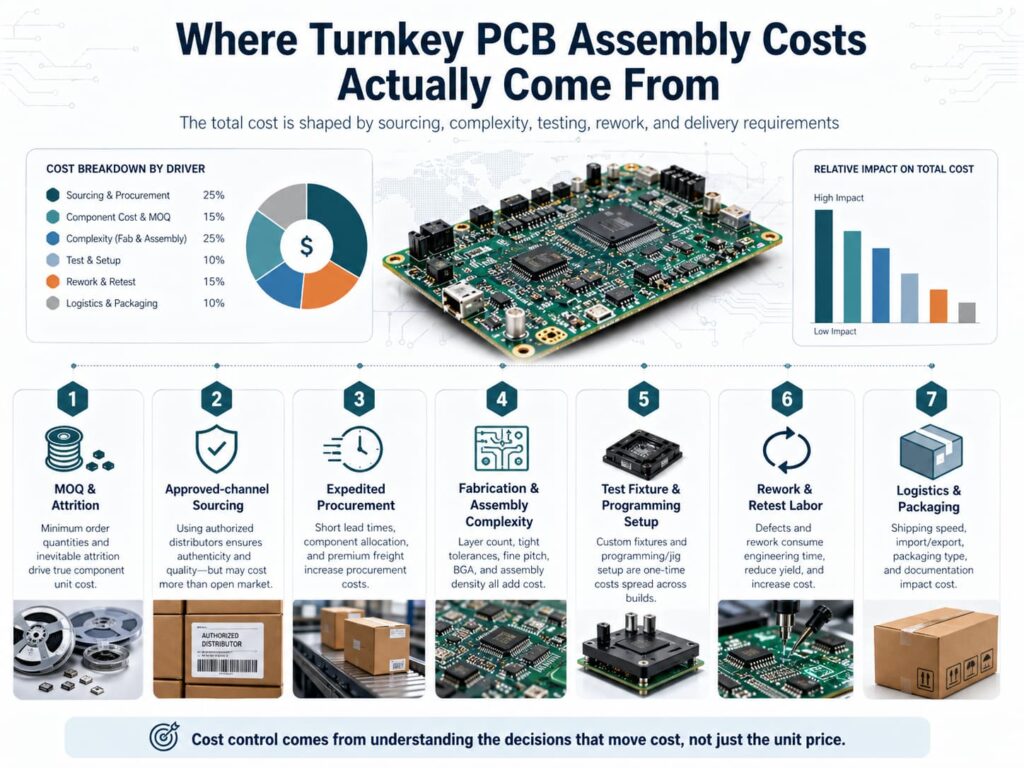
The common discussion of turnkey PCB assembly costs usually causes product unit price to be perceived as the only cost factor. While unit price is one component, it underestimates the different classes of cost involved in producing a turnkey PCB assembly. Total cost results from the chain of events from material sourcing through testing, rework, approval, documentation, and logistics.
Cost items can usually be viewed through the quote; however, many cost items are not evident until a project encounters material delays, documentation gaps, test fixture setup, or build and design exceptions.
The cost discussion should begin with the issues that create cost rather than pricing alone. By understanding which decisions cause cost movement, project teams can review the correct cost drivers when making design changes instead of treating all cost changes as purchasing issues.
Material sourcing is not just purchasing
When customers and suppliers source materials, they do more than buy parts to match the design. The buyer verifies availability, matches manufacturer part numbers, reviews lifecycle risk, manages alternates, consolidates documentation, and ensures the assembly being built matches the approved BOM.
Various sourcing conditions can increase procurement costs even if the design is unchanged. For example, excess material costs arise from two distinct factors: mandatory procurement MOQs and necessary production attrition, such as feeder setup, tape leader loss, handling loss, or placement-related overage. Likewise, some components can only be sourced through an approved or authorized source and may carry a premium compared with less controlled paths.
Expedited procurement can also increase cost. When a build depends on a constrained component, the cost may reflect not only the part itself but also search effort, supplier communication, documentation review, split sourcing, and additional incoming checks.
A small part in the kit can affect the entire project. If this part prevents the kit from being completed, it may require engineering review or alternate evaluation. Approved manufacturer part numbers, substitute rules, lifecycle notes, and do-not-substitute markers help reduce additional sourcing effort when an alternative is needed.
Fabrication and assembly complexity still matter
Fabrication and assembly complexity cannot be ignored because PCB fabrication and assembly affect the actual assembly price. Board layer count, material, controlled impedance requirements, via structure, surface finish, component density, fine-pitch placement count, and assembly method can all change the production path.
These factors are closely tied to the turnkey process. If a supplier can coordinate both fabrication release and assembly planning, design or documentation issues can be detected before production starts. Examples include stack-up issues, incomplete assembly drawings, or incomplete revision data that create review loops before production.
These factors also affect how materials are planned and inspected. Fine-pitch components, moisture-sensitive devices, bottom-terminated packages, mixed SMT and through-hole processes, selective soldering, and manual processes may require different process planning, increase inspection focus, increase rework exposure, and change operator instructions.
The customer’s control point is release quality. The fabrication files, assembly data, BOM, drawings, test expectations, and revision notes should tell the same story. If they do not, the supplier may spend as much effort troubleshooting contradictions as building the product itself.
Testing, programming, and fixture setup can be real cost drivers
Test and inspection setup effort is equally important. Testing may require creating or modifying a fixture, creating test scripts or procedures, configuring support hardware, documenting the test procedure, and creating a golden sample.
Firmware programming may also add cost, particularly if the product requires serialization, hardware configuration, verification after programming, or similar steps. Even a simple firmware program needs control so the firmware version, hardware revision, and test procedure agree with the released build package.
Fixtures can be difficult to estimate because they require design, development, maintenance, storage, and control. When a board design changes, the fixture and test procedure may need review. Therefore, “testing included” is not unambiguous; cost depends on the evidence required by the customer and how that evidence will be provided.
Rework exposure is another hidden cost. Examples include assembly quality issues, design-for-manufacturability problems, substitution of a non-designated component, incorrect documentation, inadequate handling, or unclear acceptance criteria. In a turnkey model, it is important to know not only who performs the rework but which earlier control point failed to prevent the issue or make it visible sooner.
Retesting labor is just as important as first-time assembly. Repaired boards may need to repeat inspection, electrical checks, programming verification, or functional testing. Rework may also require engineering review, customer communication, and documentation updates because many grey areas appear when acceptance rules are unclear.
For example, a board may pass visual inspection but fail functional testing due to a substituted oscillator, regulator, or programmed device that behaves differently in the operating sequence. The cost is not just the failed board; it can include failure isolation, rework, retesting, and corrective action approval. If a substituted component was not evaluated against the original device requirements, the substitution criteria may also need review.
Acceptance definition is the customer control point. It establishes agreement on test coverage, inspection expectations, rework limits, documentation requirements, and exception handling before the build begins.
Documentation, traceability, logistics, and packaging are part of cost
Turnkey PCB assembly cost also includes documentation and traceability expectations. A basic build record provides a summary, while a detailed documentation package may include material traceability, lot and date codes, inspection reports, test logs, deviation records, approved alternates, and shipment records.
Packaging and logistics can also affect cost. Moisture-sensitive and ESD-safe packaging, labeling, serialization, export documentation, packaging materials, and location-specific shipment requirements may affect project cost beyond assembly.
It is easy to overlook these costs when the project is viewed only at board level. They are part of converting the assembled PCB assembly into a controlled deliverable.
Overall, the costs associated with turnkey PCB assembly arise from the complete chain of execution, not just purchasing inputs or assembly. The most effective method of controlling costs is to understand and own the decisions that can cause costs to change.
Testing Boundaries and Acceptance Criteria in Turnkey PCB Assembly
When choosing a supplier for your turnkey PCB assembly service, the test process should be viewed as an acceptance-boundary control rather than a vague promise that inspection will find and correct defects later. A supplier may perform inspection and testing, but the customer must identify what each test is expected to demonstrate and what evidence will be maintained.
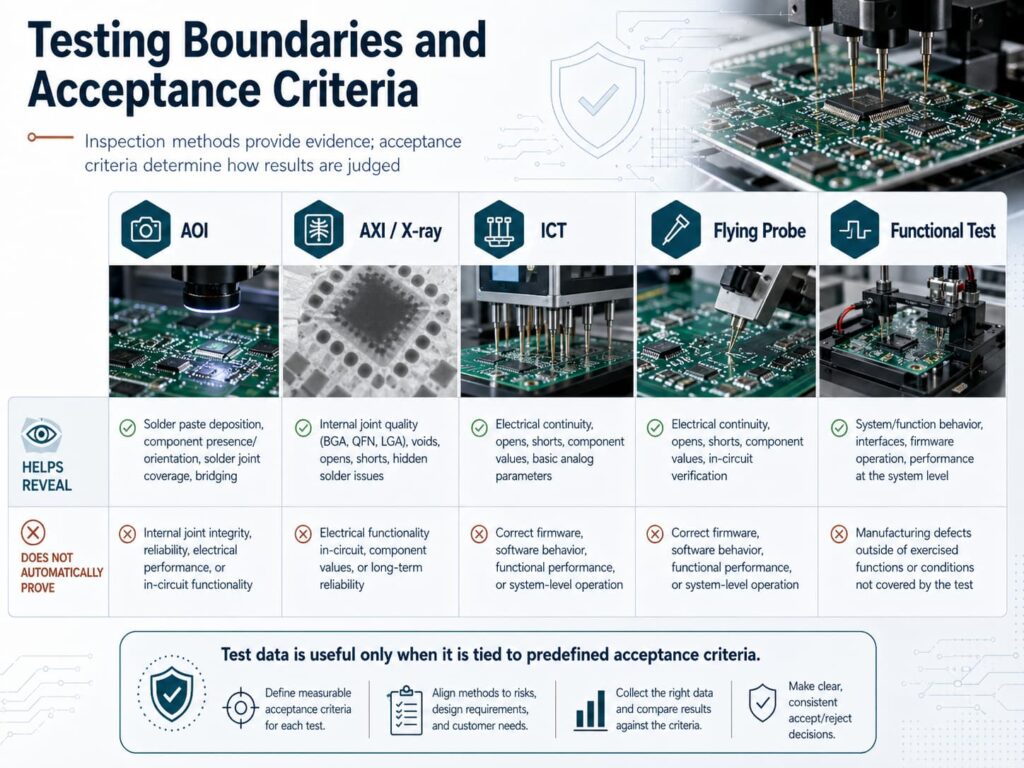
The distinction between inspection methods and acceptance criteria is important because the two are not interchangeable. Inspection methods indicate how required inspections are performed, while acceptance criteria indicate how results are evaluated.
Define test requirements before the build
It is vital to establish test requirements before sourcing the PCB and beginning the assembly process. If they are established after the project has begun, the project may encounter problems related to fixture preparation, documentation, firmware, access points, golden sample boards, or pass/fail criteria.
Although a turnkey supply chain can facilitate test execution, test execution still requires controlled inputs. The build package should identify whether the project requires visual inspection records, electrical continuity tests, powered functional tests, programming confirmation, customer-provided test protocols, or production test data.
The build package should also specify who reviews exceptions to test criteria and how authorization for retests or rework will proceed. If these boundaries are not established ahead of time, testing may become a point of contention after the PCBs have already been manufactured.
Use common methods as coverage examples
Common inspection and testing methods are detailed in this section and may include Automated Optical Inspection (AOI), Automated X-ray Inspection (AXI), In-Circuit Test (ICT), flying probe testing, and functional testing. Each test method will detect a different type of issue.
AOI is commonly used to inspect visible assembly conditions, including component presence, polarity, placement, and solder appearance. AXI can help inspect hidden solder joints or internal connection features that are not visually accessible from the surface of the PCBA. ICT and flying probe testing can help verify electrical connectivity or selected component-level conditions. Functional testing checks whether the assembled PCBA performs according to an agreed-upon operating procedure.
These methods should be viewed as coverage tools, not interchangeable guarantees.
Acceptance criteria vs. inspection method
Using a test method does not automatically equate to using acceptance criteria. For example, a functional test may demonstrate that a PCBA powers up and performs a specified operation; however, the customer must determine expected inputs, outputs, limits, firmware state, and pass/fail conditions to provide a proper basis for approval.
This same principle can apply to inspection methods used. An image, X-ray result, continuity check, or functional test log can yield useful evidence to support the inspection process. However, the interpretation of that evidence, whether positive or negative, can typically be established only through a common understanding between the customer and manufacturer.
An example of a discrepancy between AOI and functional test results is as follows: a board may pass AOI but fail functional testing. Even though the board may exhibit good physical placement and solder appearance, the circuit may still fail due to a firmware mismatch, incorrect component variant, marginal power performance, incorrect programming state, or latent design issues or functional mismatches that fall outside the scope of visual inspection.
Acceptance criteria for turnkey PCB assembly should relate acceptance to project risk. For example, consumer Internet of Things (IoT) boards will not have the same type of evidence package as an industrial controller, medical device companion accessory, or aerospace supporting module. Therefore, it is best to establish acceptance criteria before the assembly run, rather than after an exception is identified.
Why no test method guarantees full defect prevention
Testing will reduce uncertainty but does not remove the potential for failure modes. Defects may be intermittent, environment-dependent, design-related, component-specific, or outside the bounds of the testing method selected. A board may pass an accepted defined test; however, the results should be evaluated further by engineering if the test was not created for the relevant risk.
That is why turnkey PCB assembly must separate the execution of testing from acceptance authority.
The supplier should be able to execute the agreed inspection and test flow. The customer establishes the acceptance criteria, approves exceptions, and determines when a more detailed engineering review is necessary.
Testing for improved control does not mean adding more testing by default. Rather, it means associating the test method, evidence, and acceptance criteria with the risks that are relevant to the product.
The following table summarizes test method categories, what they help identify, and what they may not prove:
Test data becomes information without authority when it is not tied to an explicit decision regarding acceptance criteria. This will typically happen when there are no acceptance criteria established prior to testing.
Frequently Asked Questions
Q1. Why do they call it turnkey?
The term “turnkey” refers to the concept that you get a complete project delivered to you and only need to “turn the key” to make it work. In the case of PCB assembly, it is true to some extent, but at the same time, it indicates how much of the execution path, such as sourcing, assembly, inspection, and delivery flow, is being managed by the supplier. However, the term “turnkey” does not mean the customer loses control of approved parts, engineering changes, or acceptance criteria.
Q2. What does turnkey mean in engineering?
In engineering, the term “turnkey” usually describes a project delivery model in which one party takes responsibility for an agreed package of work and delivers that completed product to another party. The key part of this definition is the word “agreed.” A turnkey project still requires that the customer’s documentation has been released, the technical boundaries of the project have been determined, the customer’s approval process has been defined, and the customer has defined the acceptance conditions for the final product. The turnkey PCB assembly model describes a process where suppliers of assembled PCBs typically perform many of the operational functions required to build an assembly; however, customers still control the design intent, material changes, and acceptance conditions.
Q3. What does PCBA stand for?
PCBA is an abbreviation for “Printed Circuit Board Assembly.” Once components have been attached and soldered to a printed circuit board and inspected to prepare it for its intended use, the printed circuit board is referred to as a PCBA. The term PCBA allows for the distinction between the bare board and the assembled electronic device. In discussions of turnkey PCB assembly, the term PCBA is generally used to refer to either the final assembled PCB or a partially assembled PCB, including the PCB, components, solder joints, and associated inspection or test reports.
Q4. What is the difference between PCB and PCBA?
PCBs, or printed circuit boards, provide the physical structure and conductive pathways that make up an electronic circuit; however, since a PCB does not yet have parts mounted onto it, it does not function as an assembled electronic unit. A PCBA, or printed circuit board assembly, is a PCB that has had its parts installed and soldered onto it. When dealing with turnkey projects, the difference between these two terms is important. This is because fabrication risk, component sourcing risk, assembly risk, and test acceptance risk can occur at different points within a project’s workflow.
Q5. Why is PCBA so expensive?
One of the reasons that PCBA may seem expensive relates to the fact that it is not simply placing components on the PCB, but encompasses the entire process. PCB fabrication complexity, material sourcing complexity, component lifecycle issues, inspection and testing procedures, potential rework, documentation, and logistics all contribute to the overall cost. For turnkey PCB assembly, many of these factors are combined into a single execution path. As a result, it is often easier to manage the cost of turnkey PCBAs on an operational basis, but it can be challenging to interpret cost drivers if underlying cost structures are not available to view.
Q6. What are two advantages of turnkey projects?
Integration and coordination are two of the primary advantages of turnkey projects. Through a connected workflow, sourcing, fabrication coordination, assembly, inspection, and delivery can all be handled more efficiently. The coordination advantage allows for fewer handoffs between purchasing, board fabrication, assembly, and logistics. Both of these advantages are dependent upon clear control points throughout the process. Ambiguity surrounding component approval requirements, alternate part specifications, and test limits can turn the turnkey concept into more of a visibility-related issue than a solution for project friction.
Q7. Who approves component substitutions in turnkey PCB assembly?
The customer is responsible for approving any component replacement that will have an impact on form, fit, function, reliability expectations, lifecycle position, software operation, or documented assumptions for the product. The supplier may identify and suggest alternates to the customer, but the proposal and the approval are separate activities. Sources of routine alternate components can be defined prior to assembly by creating an approved list. Any component that is not already on the qualified list will have to go through a defined engineering review cycle prior to inclusion as part of the build.
Q8. Does turnkey PCB assembly reduce customer control?
Turnkey PCB assembly has the potential to reduce the burden of administrative activity for the customer; however, it is not intended to take away the customer’s ability to control engineering decisions. Although the customer may not have direct control over every sourcing activity and handoff during production, the customer must retain ownership of released documents, approved parts, substitution guidelines, test criteria, and acceptance criteria associated with each produced assembly. The risk occurs when the customer confuses the convenience of one-stop coordination with permission for unrestricted changes.
Q9. Why can turnkey PCB assembly cost change after review?
Changes in cost after review can happen due to previously hidden issues or challenges that the supplier has discovered during the build review. Examples of issues that can affect cost include obsolete components, minimum order quantities, attrition considerations, approved-channel sourcing premiums, functional test fixture setup, programming requirements, rework, packaging, and missing documentation. All cost changes incurred should be investigated to determine the source of the increased costs, not treated simply as a price increase.
Q10. What is the difference between test results and acceptance criteria?
Test results provide evidence; acceptance criteria determine how that evidence will be evaluated. A functional test log is an example of a document that can provide evidence from functional testing; however, the criteria that must be met still must be agreed to by both parties to support product release. The supplier conducts the testing, while the customer defines what the test results must establish and how to handle exceptions.
Q11. When is partial turnkey better than full turnkey?
A partial turnkey approach will tend to be more suitable where the customer needs direct control over specific components. This includes situations where the customer has proprietary integrated circuits (ICs), allocated components, pre-qualified materials for their product, programmed devices, or components tied to internal contractual agreements. The supplier can still provide management of the rest of the sourcing and assembly workflow. The partial turnkey approach will work most effectively if there is a clear division of material ownership, and customer-provided parts arrive with the correct revision, labeling, quantity, and documentation.
Conclusion
A turnkey PCB assembly system is not one that sacrifices your ability to control it. Instead, it allows you to consolidate the responsibility for producing PCB assemblies into one organization through an integrated workflow — while you still have approval authority over materials, design intent, sourcing boundaries, and acceptance criteria.
The best turnkey projects are not simply determined by what the supplier does, but rather by how clearly all decision points are defined. The decision on material selection, when alternate approvals will be allowed, what the test plan will consist of, what the documentation requires, and what conditions will be accepted all affect whether your model reduces friction or creates hidden risks.
A simple principle for practical decision-making is to allow the supplier to manage execution, but not to let the convenience of that execution replace your control over engineering. If the supplier and client understand that execution and authority have to be separated before production begins, then the turnkey assembly process becomes an established operating model instead of an unmanaged outsourcing arrangement.
References & Sources
- IPC-A-610 – Revision H – Standard Only: Acceptability of Electronic Assemblies — electronics.org
- IPC-J-STD-001 – Revision H – Standard Only: Requirements for Soldered Electrical and Electronic Assemblies — electronics.org
- IPC-1782 – Revision B – Standard Only: Standard for Manufacturing and Supply Chain Traceability of Electronic Products — electronics.org
- IPC-1602 Standard Only: Standard for Printed Board Handling and Storage — electronics.org
- IPC-9716 – Standard Only: Requirements for Automated Optical Inspection (AOI) Process Control for Printed Board Assemblies — electronics.org
- IEC 62402:2019 — IEC
- AS5553 Counterfeit Electronic Parts; Avoidance, Detection, Mitigation, and Disposition — SAE Mobilus
- Subpart 1846.70—Counterfeit Electronic Part Detection and Avoidance. — Acquisition.GOV
- An Overview of ANSI/ESD S20.20 — EOS/ESD Association, Inc.


