
Upload BOM & Gerber

It is not possible to convert amps into watts from amps alone since voltage is needed to complete the relationship between the two quantities. The voltage must be characteristic of the same electrical side and the same operating conditions as the current (amps). For steady DC, power is calculated by multiplying voltage by current. For AC, you may also need RMS values, circuit topology or wiring configuration, and the true power factor of the load to convert amps into watts.
Contents
show
Can You Convert Amps to Watts Without Voltage?
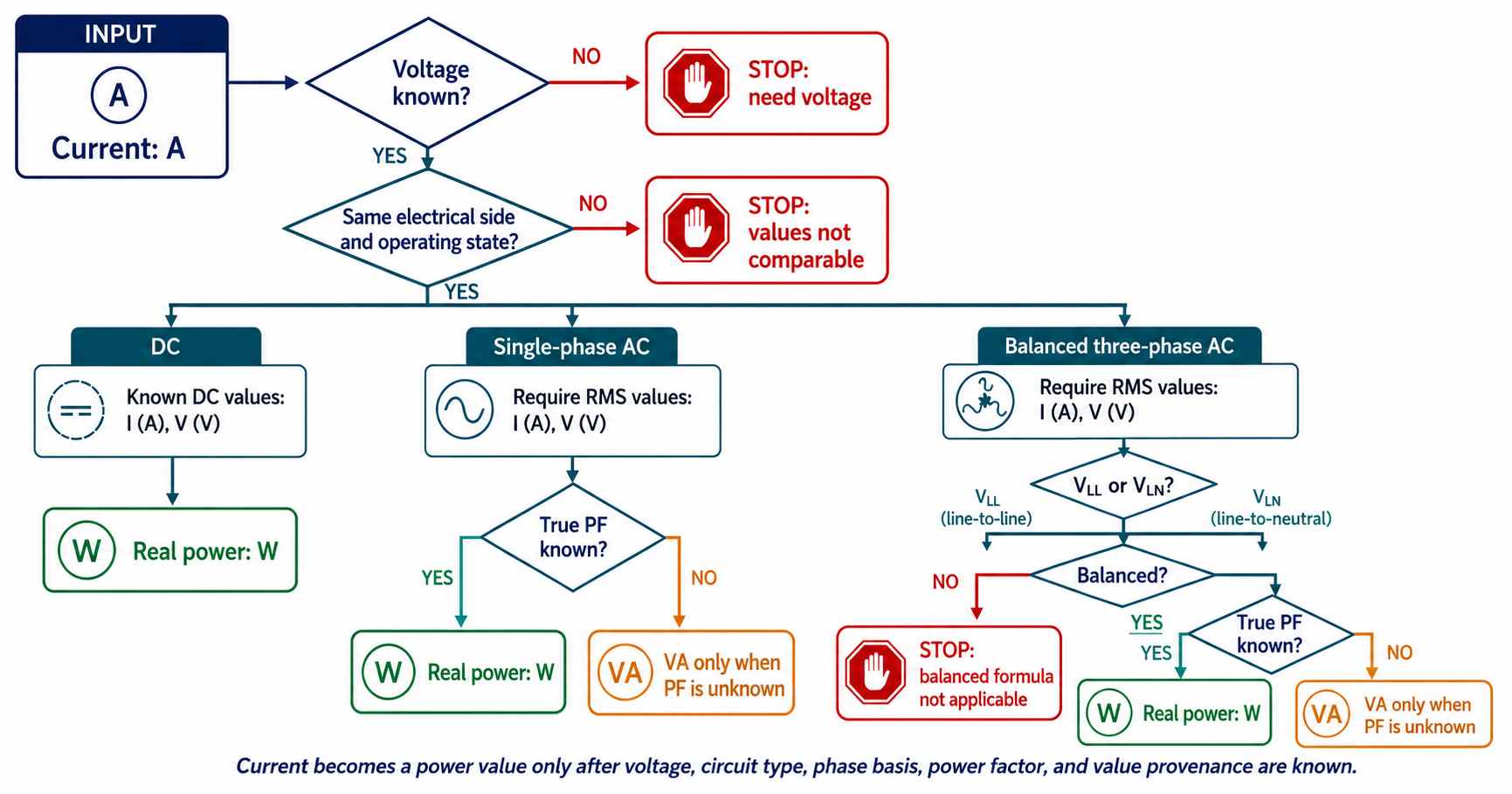
No; "amps" describes only the rate of electrical charge flow through the conductor — therefore, nothing in that "amps" value provides any indication about the amount of energy delivered per second.
Voltage provides the missing link for this calculation. As stated by NIST, "1 Volt = 1 Watt per Ampere" (1 V = 1 W/A). Thus, you can obtain electrical power in watts by multiplying volts by amperes, provided that you are measuring under the same electrical conditions. In the case of AC systems, the calculation must also take into account power factor and phase conditions in order to know whether the product represents real electrical power or only apparent electrical power.
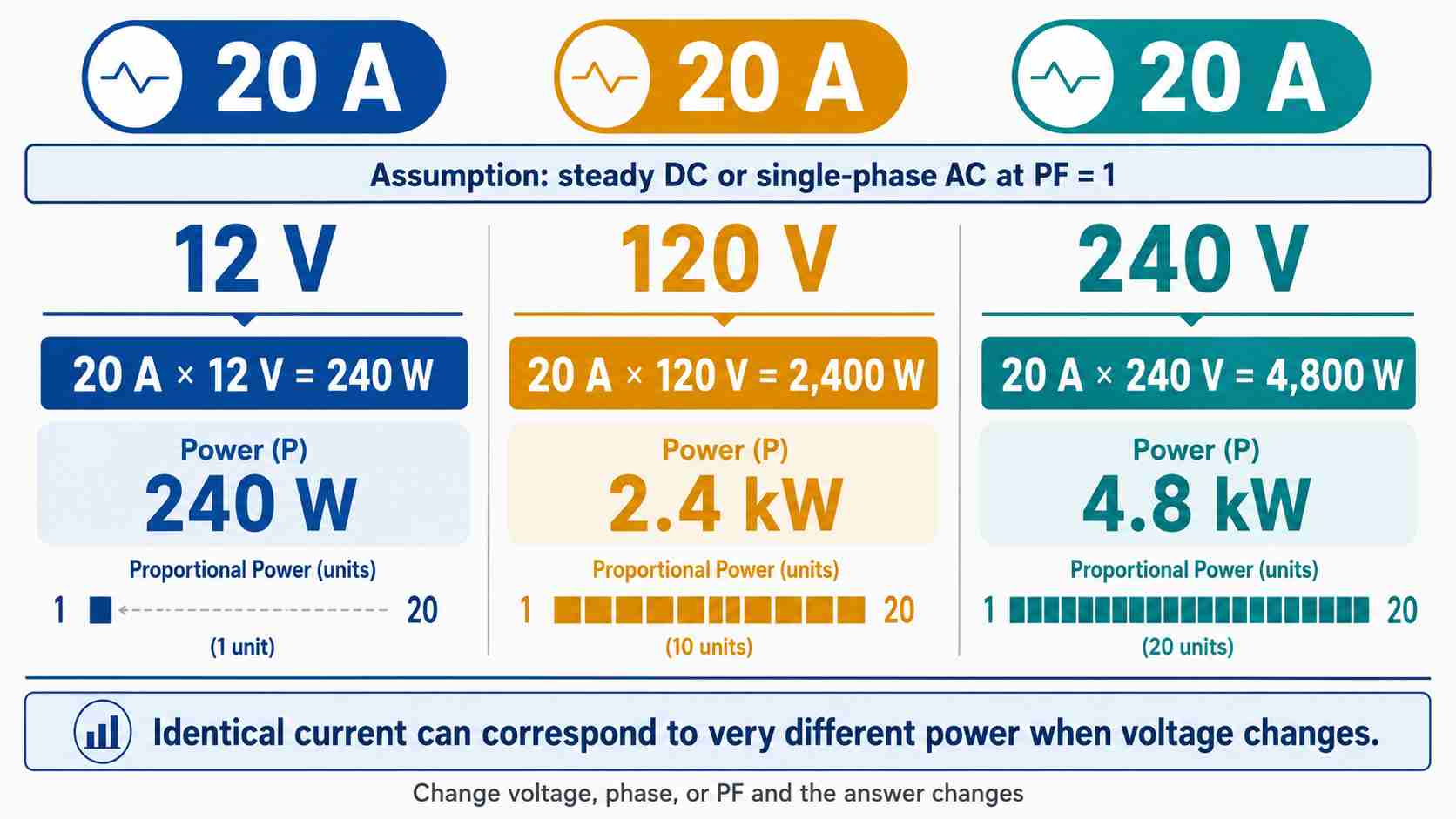
At 20 amperes of current, the dependency is straightforward to see; e.g. at 20 A, 12 V = 240 W; 20 A, 120 V = 2,400 W; and, finally, 20 A, 240 V = 4,800 W for steady DC or single-phase AC at true PF = 1.
Which Voltage and Current Values Belong in the Same Calculation?
When determining voltage and current values to include in one calculation, use those from the same electrical side, operating state, and rating context.
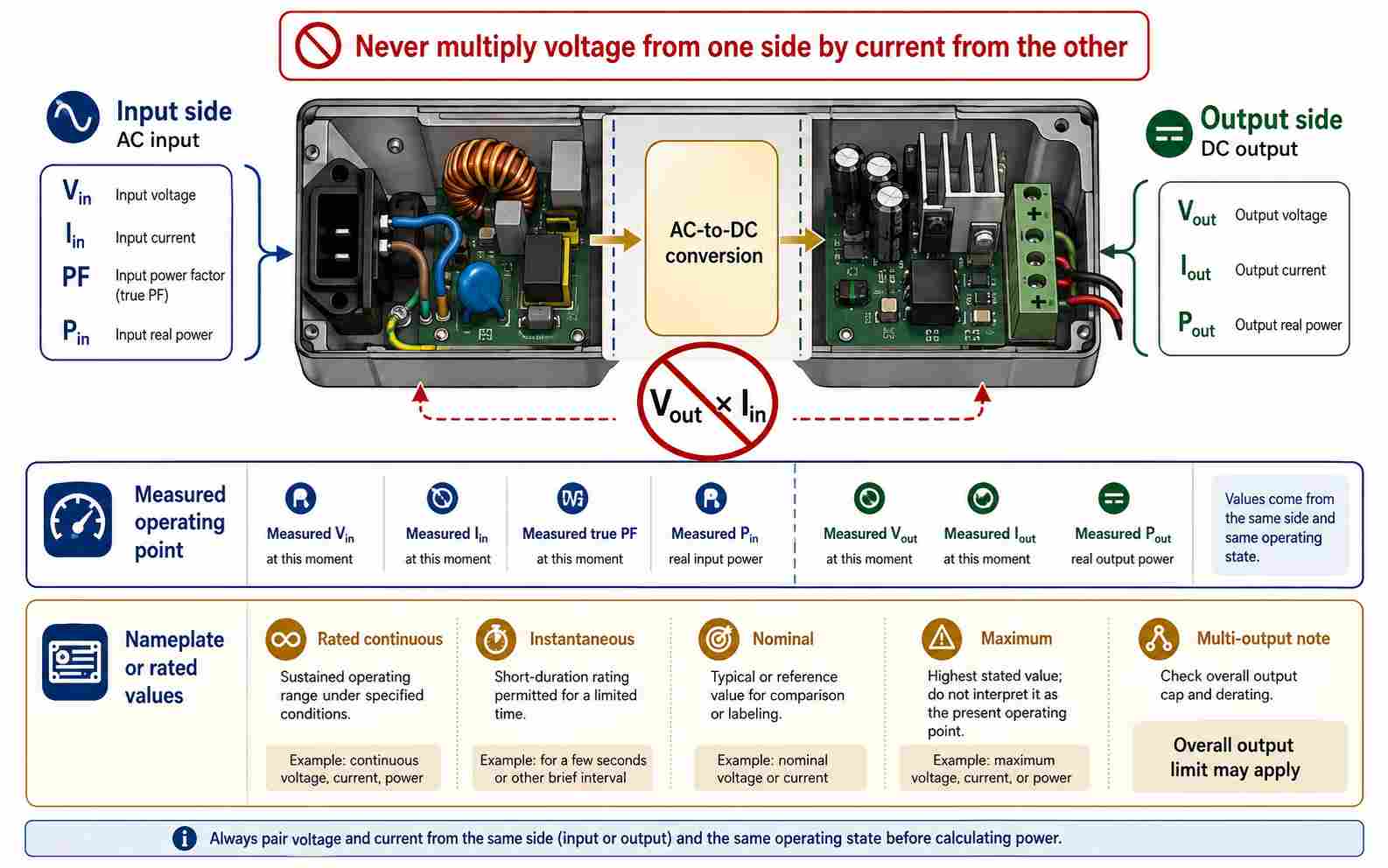
It is possible to have both the AC input rating and DC output rating of a power supply (adapter) listed on one label. However, the two ratings represent completely different power boundaries. Sometimes, you may see the DC output voltage multiplied by the AC input current to give a number with watt units, but it has no meaning in terms of a true operating point. The same concept applies when you treat the highest rated current (maximum) as if it were the actual continuous current that a given load requires.
Values provided for "Nominal" and "Maximum" indicate the conditions specified on the label, but they do not necessarily indicate an actual operating point at that moment. Additionally, for a power supply that has multiple outputs ("rails"), the combination of maximum ratings for each rail may be greater than the total rated output of the power supply; therefore, before calculating how much power an adapter is capable of supplying to a load, determine the terminal or rail to be used and the voltage and current associated with that rail or terminal.
Amps to Watts Formulas for DC and AC
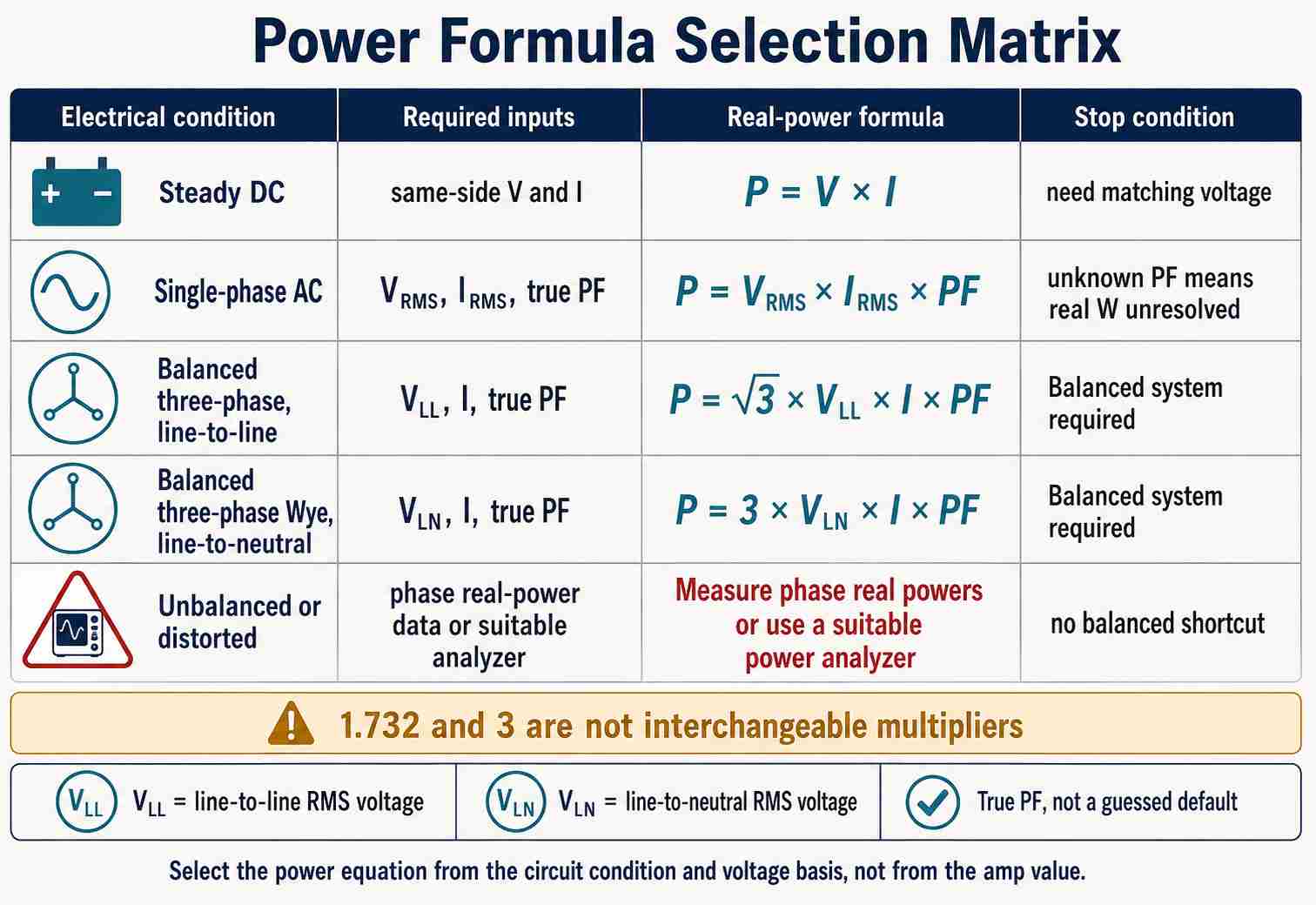
The formula used to calculate electrical power depends on the circuit topology and voltage basis, not on the amount of current being used. The formulas below can provide the watts of real power as long as the conditions stated for each formula are met.
To do the reverse of this conversion, you simply rearrange the same relationships shown above.
DC: I = P ÷ V
Single-phase AC: I = P ÷ (V × PF)
Balanced three-phase AC using line-to-line voltage: I = P ÷ (√3 × V_LL × PF)
The balanced three-phase AC shortcut does not apply when the system is unbalanced or when the line-to-line voltage basis is not known.
The relationship between watts and VA can generally be explained through PF. However, do not rely on a typical PF to determine the values of AC watts and VA until you have either a measured or manufacturer-provided true PF value. The PF can change due to the load conditions on a motor, power supply, or electronic drive; additionally, waveform distortion can also change the PF.
How to Calculate Amps to Watts
An example of a common way this conversion goes wrong: You see “2,000 mA” on a label; you multiply that by 12 volts without converting 2,000 mA to amps first, then you've already made a mathematical error by a factor of 1,000.
12 V DC electronics example
Theoretical output power for a 12 V DC output at 2 A: power (P) = 12 V × 2 A = 24 W. However, if the 2 A value is only the maximum output rating, 24 W is a rating-based ceiling at that voltage and does not prove that the connected device continuously consumes 24 W of power. Do not combine the 12 V DC output voltage with an AC input-current value from the other side of the adapter.
120 V single-phase AC example
For a 120 V RMS load drawing 10 A RMS with a true power factor of 0.80: apparent power = 120 V × 10 A = 1,200 VA, whereas real power = 120 V × 10 A × 0.80 = 960 W — therefore, volts × amps alone cannot verify real power in watts at an AC power factor of less than 1.
400 V balanced three-phase example
Theoretical output power for a balanced three-phase load at 400 V line-to-line using 30 A as the line current and a power factor (PF) of 0.90: P = √3 × 400 V × 30 A × 0.90 = 18,706 W or approximately 18.71 kW. Note that the 400 V value must be line-to-line when determining P using this form. For line-to-neutral voltage in a balanced Wye system, use the three-times-per-phase relationship to calculate power.
Amps to Watts Conversion Chart
Although each entry in the charts below represents a voltage-specific answer for a current-to-power relationship, changing the voltage changes the watt value for the same current; the conversion charts assume steady DC or single-phase AC at true PF = 1 unless noted otherwise.
Common amps-to-watts examples
One amp is not always equal to a fixed number of watts. For example, carrying over a shortcut such as “1 A is roughly 5 W” from a USB charger and applying it to a 220 V appliance rating will produce an incorrect result because the voltage is different.
Common watts-to-amps examples
Knowing a wattage value alone does not tell you the current draw until you know the voltage at which the device will operate.
The use of these conditional arithmetic results when sizing a conductor, breaker, inverter, or generator ignores the many other factors involved in the thermal, transient, efficiency, coordination, environmental, and regulatory information required to make those types of decisions.
When Does Volts × Amps Give VA Instead of Watts?
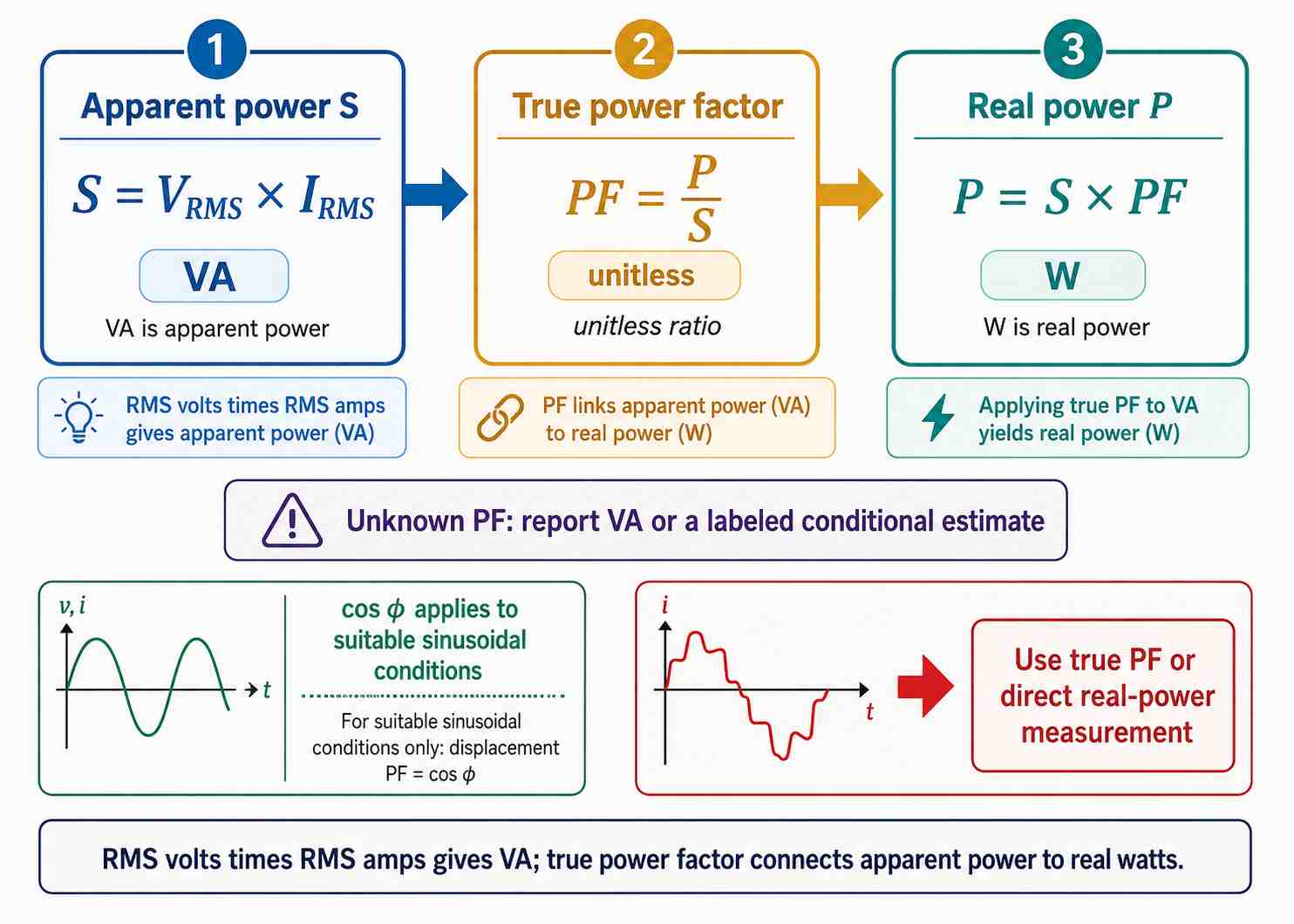
RMS volts multiplied by RMS amps gives you the apparent power (VA) in a single-phase AC circuit. The apparent power is given by S = (V_RMS)(I_RMS), PF is given by PF = P/S, and P = S × PF. If the actual PF is not known, report your result as VA or clearly indicate the PF assumption used rather than presenting the result as confirmed watts. When distorted waveforms exist, the actual PF considerations go beyond the use of just the phase angle (φ) between ideal sine waves; therefore, using just cos φ may not accurately provide the correct PF.
Common Amps-to-Watts Mistakes
- Amps are treated as watts when there is no voltage.
- Confusion between input and output values.
- Disregarding PF during AC calculations.
- Using the incorrect three-phase voltage basis.
- The maximum rating cannot be assumed to represent actual consumption.
References & Sources
- Ampere: The SI Base Unit of Electric Current – International Bureau of Weights and Measures
- The International System of Units (SI Brochure), 9th Edition – International Bureau of Weights and Measures
- SI Units: Electric Current – National Institute of Standards and Technology
- Watt – National Institute of Standards and Technology
- IEEE Standard 1459-2025: Definitions for the Measurement of Electric Power Quantities – IEEE Standards Association
- Fundamentals of Electric Power Measurements – Yokogawa Test & Measurement
- How to Measure Electrical Power – Yokogawa Test & Measurement
- Total Power Calculation for Accuracy Verification Testing – Schneider Electric
- External Power Supplies – U.S. Department of Energy
- Low-Voltage Direct Current Terminology and Definitions – International Electrotechnical Commission


